Geomechanics, Streamlined.
© 2026 Geomechanics.io. All rights reserved.
Gold prices slipped to a one-week low as spot gold fell 0.4% to $4,271.16/oz in New York and December futures eased 0.3% to $4,306 amid a stronger US dollar and expectations of more hawkish US Federal Reserve rate moves. The dollar hit a two-month high and US 10-year Treasury yields hovered near a 20-year peak, sharply raising the opportunity cost of holding non-yielding bullion. Oil gained about 1% on stalled US–Iran talks over the war, while spot silver dropped 1.8% to $63.29/oz, platinum 0.2% to $1,746.44, and palladium rose 0.5% to $1,266.40.
OceanaGold is weighing a 50% expansion of its Waihi plant to 1.2 Mt/y after Wharekirauponga drilling returned standout intercepts including 6.3 m at 97.2 g/t Au from 481.5 m in the East Graben vein and 8.5 m at 41.5 g/t from 399 m. The move would enable concurrent feed from Martha Underground and Wharekirauponga post‑2032, building on a 2024 plan outlining 1.6 Moz over 15 years and an initial 4.1 Mt reserve at 9.2 g/t. Underground development is advancing, with the Waihi North decline now 350 m, first vent shaft under construction, staged commissioning of a new water treatment plant, and early works on a new tailings storage facility due in Q4.
Kinross Gold has cut its 2026–27 production outlook by about 8% to 1.84–1.86 million attributable gold-equivalent oz. a year and raised 2024 AISC guidance to $1,850–$1,900/oz after winter storms, copper-rich sulphide ore and poor recoveries at La Coipa in Chile, plus weaker mining rates, grades and recoveries at Round Mountain Phase S in Nevada. The company is stockpiling high-copper material, studying a new flotation circuit for deeper sulphide mineralisation that may overlie a copper porphyry system, and using a smaller shovel at Round Mountain to cut dilution. Despite the operational hit and a Q3 output cut to about 425,000 oz., Kinross has lifted its 2026 shareholder return target to 50% of free cash flow and has already returned about $800 million this year, mainly via $655 million in buybacks.
Rainbow Rare Earths has secured an offtake and processing memorandum with Neo Performance Materials covering 40% of Phalaborwa’s separated NdPr oxide and 65% of its mixed SEG+ heavy rare earth carbonate, enabling a prefeasibility study in Q4 and pushing the definitive feasibility study to the first half of 2027. Neo will supply solvent extraction design and technical support, with test work on phosphogypsum-derived feed under way in Estonia and an integrated pilot planned in Johannesburg, de-risking the complex separation of dysprosium, terbium and yttrium. The $326 million project would recover magnet rare earths from legacy fertiliser gypsum stacks, potentially feeding Neo’s Estonian separation and sintered magnet plant and offering a non-Chinese supply route linked to European capacity.
Rio Tinto plans a major expansion of its metals trading arm into third‑party material and derivatives, leveraging spare alumina and copper capacity rather than limiting activity to its own output. The move, led by chief commercial officer Bold Baatar, targets markets where existing assets give an edge, including alumina imbalances between regions and unused smelting capacity at the Kennecott copper operations in North America, and may extend to copper cathode and sulphuric acid. The commercial team of about 20 traders is set to grow, and Rio is in talks with Vitol on a freight and logistics joint venture.
Glencore will begin trading on the Australian Securities Exchange on 14 October under ticker GLC via CHESS Depositary Interests, each representing one ordinary share, without issuing new equity or raising capital. The Swiss miner is targeting access to Australia’s A$4.4 trillion pension market to fund copper growth and potential acquisitions, after previously exploring a New York listing and a coal spin-off. UK and South African shareholders can convert existing holdings into ASX-listed CDIs from 24 September, with Computershare managing the Australian register.
Sandvik Australia has launched its 2026–2028 Innovate Reconciliation Action Plan, marking a decade of formal reconciliation work and setting a minimum target of 3.5% Aboriginal and Torres Strait Islander representation in its workforce. The two-year RAP also commits to increased First Nations supplier participation in Sandvik’s mining equipment and services supply chain and to structured cultural capability training across its Australian operations. For mine owners and contractors, the plan signals growing expectations for Indigenous employment and procurement benchmarks in OEM tendering and project partnerships.
Accenture has launched Accenture Construct, a global business combining its capital projects advisory, engineering, project delivery and technology services to support large, complex infrastructure and mining developments. The unit consolidates a capital projects practice that has grown fourfold in three years, targeting fragmented delivery across EPCM contracts, multi-vendor digital systems and dispersed project controls. For mine owners, the move signals more integrated support for mega-project planning, schedule and cost control, and data-driven optimisation across the full asset lifecycle.
AIC Mines is moving to acquire the Mt Cuthbert copper project in north-west Queensland via a $120 million deal to purchase 100 per cent of Materra Metals. The transaction comprises $100 million in AIC shares and a $20 million cash component, giving AIC a second operating hub alongside its Eloise copper mine, 60km away. The close proximity of Eloise and Mt Cuthbert suggests potential for shared processing, consolidated infrastructure and regional optimisation of underground and open-pit copper operations.
Core Lithium has restarted mining and processing at its Finniss lithium operation in the Northern Territory, reporting $17.8 million in revenue for the 12 months to 30 June as it transitions out of care and maintenance. The company now targets steady-state production by 2028, backed by a materially stronger cash position after a difficult price environment for spodumene concentrate. For mine planners and process engineers, the restart signals renewed demand for contractor services, drilling, and plant optimisation as Finniss ramps back towards nameplate throughput.
Global Lithium Resources has accepted a $333 million all-cash takeover by Titan Australia Mining via a binding scheme implementation deed, with shareholders to receive $1.15 per share. The offer implies a material premium to Global Lithium’s pre-deal trading price and secures 100 per cent ownership for Titan. For lithium project developers and offtakers, the deal signals continued consolidation in Australian hard-rock lithium assets and a preference for cash-backed transactions over scrip in current market conditions.
Auric Mining has reported strong new drilling results at the Munda gold project near Widgiemooltha, WA, as it works towards restarting open-pit mining in 2027. Broad-spaced reverse circulation drilling is testing resource extensions beyond the current pit shell, while closer-spaced grade-control holes are refining ore boundaries within the planned open pit. Additional sterilisation drilling is being completed in proposed infrastructure corridors, with outcomes likely to influence final pit design, haul road alignment and plant or waste-dump siting.
Tungsten West has signed an eight-year binding offtake agreement with US-based Elmet Technologies for 1,000 tonnes per annum of contained WO₃ from the Hemerdon tungsten-tin mine in Devon, valued at over £1.4 billion at current prices. The contract secures a long-term mine-to-market route into US and UK tungsten processing and manufacturing supply chains, alongside the UK National Wealth Fund’s investment of up to £71 million and its exclusive talks to procure up to 50% of Hemerdon’s annual tungsten output. For operators and project financiers, this combination of state backing and locked-in offtake materially de-risks Hemerdon’s restart and expansion plans.
High-grade rare earth intercepts at Rare Earths Americas’ 100%-owned Homer project in Brazil’s Goiás Alkaline province include multiple near-surface intervals above 2,000 ppm TREO over >10 m within clay-hosted soil and saprolite profiles. A fully funded US$5 million, 15,000 m reverse circulation and diamond drilling programme, now running four rigs, has already drilled 6,500 m and confirmed mineralisation across ~2.15 km², less than 7% of the 35 km² ring-shaped magnetic anomaly. Assays show heavy rare earth enrichment with HREO >30% of TREO, NdPr >25%, Dy+Tb >2%, plus niobium, tantalum and notable scandium requiring metallurgical evaluation.
BHP has suspended all operational activities at the Escondida copper mine in Chile’s Antofagasta region after a worker was killed during maintenance involving a front-end loader, with Chile’s Sernageomin deploying a regional investigation team to site. The fatality comes as BHP, which holds a 57.5% stake in Escondida alongside Rio Tinto’s 30%, is in contract negotiations with mine workers, with a vote due by the end of September. Any prolonged shutdown or subsequent strike could materially disrupt output at the world’s largest copper mine.
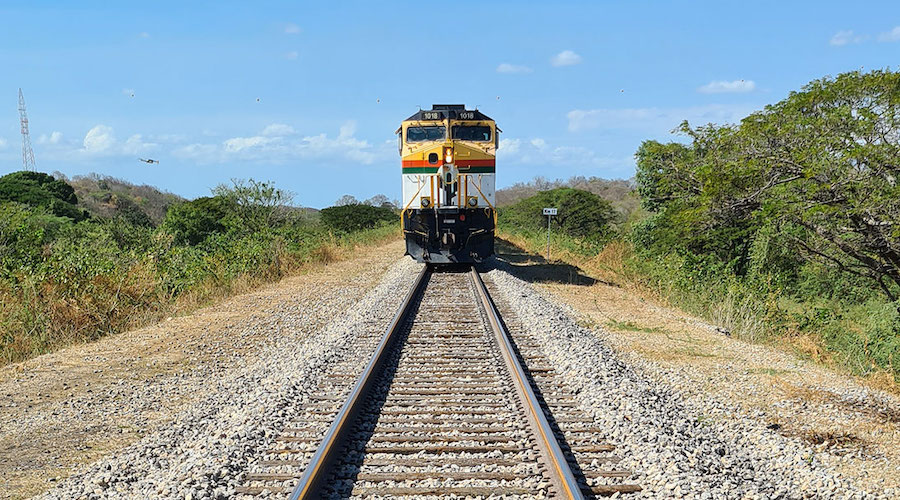
Glencore has halted rail operations at its Cerrejón coal mine in Colombia after explosives hit its 150 km railway near Uribia, La Guajira, damaging a train in the sixth attack on the corridor this year. The mine itself, one of the world’s largest open pits with 2025 output of 16.8 million tonnes, continues operating while the National Army secures the line and engineers await access for damage assessment. Prolonged repairs could again choke inbound supplies and coal exports via Puerto Bolívar, exposing the operation’s heavy reliance on a single transport corridor.
Higher pre-production capital of US$1.43 billion, up 15% year-on-year, is weighing on Ivanhoe Electric’s Santa Cruz copper project even as the updated PFS lifts NPV to US$1.5 billion and extends mine life to 24 years with average output of about 74,700 tonnes of copper per year for the first 15 years. The redesign swaps a roadheader access for a Robbins Crossover TBM and a new access tunnel to reduce groundwater risk, pushing first cathode to 2029 and trimming IRR to 19% with a 4.8-year payback at US$4.75/lb copper. Shares fell 4.2% to US$10.27 as management advances EXIM Bank due diligence for up to US$1.1 billion in debt, with life-of-mine cash costs projected at US$1.47/lb and AISC at US$2.28/lb.
NexGold Mining has reported further high-grade intercepts at the Goldlund deposit in northwestern Ontario, with hole GL-26-034 cutting 13 m at 2.84 g/t gold from 205 m depth, including 8 m at 9.76 g/t and 7 m at 14.07 g/t, within quartz stockwork veining in sub-vertical granodiorite sills. Additional holes include GL-26-033 with 42.8 m at 0.84 g/t from 245.7 m and GL-26-039A with 17.1 m at 1.51 g/t from about 219 m, part of a 35,000 m programme that is 91% complete. The drilling targets Zone 4 infill and depth extensions to refine the geological model and future resource updates for the 16.2 Mt, 1.19 g/t probable reserve within the Goliath gold complex, which carries a 2023 PFS post-tax NPV of $336 million and 25.4% IRR.
Barrick’s North American business has selected Avathon’s Physical AI Autonomy Platform as a strategic layer to connect data, operational knowledge and AI models across its mining value chain. The deployment will span exploration, mine planning, safety, production, processing and maintenance, creating a single environment for ingesting sensor data, operational KPIs and engineering rules. For mine operators and engineers, this signals a push towards integrated decision support, where planning, plant control and asset health monitoring are driven from one AI-enabled operational backbone rather than siloed systems.
Highlander Silver has mandated Natixis CIB to arrange a fully underwritten US$330 million, seven‑year senior secured debt package, including a US$100 million cost‑overrun provision, to fund construction of the fully permitted Corani silver‑lead‑zinc project in Peru’s Puno region. Corani hosts 138.6 million tonnes of proven and probable reserves grading 51.3 g/t silver, 0.9% lead and 0.55% zinc (229 million oz silver, 2.7 billion lb lead, 1.7 billion lb zinc), with the 2019 feasibility outlining a 15‑year mine averaging 9.6 million oz silver per year at US$4.55/oz AISC. With about US$100 million cash on hand, expected Mercedes mine cash flow of roughly US$100 million in 2027–28, and the Natixis facility projected to cover ~72% of the ~US$460–500 million capex, BMO and Scotiabank see Corani nearing fully funded status, targeting construction start in H1 2027 and first production by end‑2029.
Former Gold Fields CEO Chris Griffith has joined a new private equity team aiming to raise $1 billion for African critical minerals projects, targeting commodities such as cobalt, copper, lithium, nickel and rare earths. He is working with former Goldman Sachs banker Colin Coleman and ex-Ashanti Goldfields chair Sam Jonah, with fundraising still at an early stage and structured as a dedicated Africa-focused vehicle. The move follows Griffith’s exit from Gold Fields after the failed $6.7 billion Yamana bid and a subsequent two-year spell leading Vedanta’s base metals division.
SuperCritical Materials Corp. has partnered with the University of Michigan to mechanically validate its uranium‑from‑seawater adsorbent for industrial‑scale offshore deployment, using hydrodynamic testing in the Aaron Friedman Marine Hydrodynamics Laboratory’s wave and current tanks. The programme will characterise the adsorbent under packing, deployment, ocean exposure and retrieval stresses, optimise packing configurations, and build and test prototypes for repeated deployment–recovery cycles. Findings will feed into a future feasibility study and nearshore pilot designs, targeting integration of seawater‑derived uranium into the US nuclear‑fuel supply chain.
US Export-Import Bank is preparing up to $7 billion in financing for Argentine critical minerals and energy projects, enabling operators to fund US-sourced equipment for lithium, copper, rare earths and shale oil and gas over the next two years. The package would build on more than $1 billion in US critical minerals commitments to Latin America since January 2025 and sits alongside Argentina’s RIGI regime, which grants tax, customs and FX stability for projects above $200 million. Key beneficiaries could include Rio Tinto’s $2.5 billion Rincón lithium project, BHP’s advancing copper developments and Chevron’s shale operations, with Argentina targeting 580,000 t/y lithium and 1.64 Mt/y copper exports by 2036.
Wolfram Bergbau und Hütten AG marks 50 years of operation as Europe’s only fully integrated tungsten producer, running mining, refining and recycling from a single chain centred on its Austrian Alps deposit. The company’s model couples primary ore extraction with secondary raw materials, using in-house recycling of hardmetal scrap and tungsten-containing residues to buffer supply risk. For mine planners and metallurgists, Wolfram’s history illustrates how regional processing capacity and closed-loop scrap flows can stabilise a critical metal traditionally dominated by Chinese concentrate and APT exports.
Tonly Heavy Industries has delivered a fleet of 75 t-class TLE120 battery electric wide-body dump trucks to the Baiyan open-pit mining area of Wengfu Phosphate Mine in Guizhou Province, China. The trucks will operate on short-haul, high-frequency phosphate ore routes at the boundary of Weng’an County and Fuquan City, where haul profiles and predictable duty cycles favour battery swapping and regenerative braking. For mine planners and haulage engineers, the deployment signals growing Chinese adoption of large battery-electric trucks in high-volume open-pit phosphate operations.
Jevons Robotics has launched the ARTEV1000 Pre-Split System, a battery-electric robotic platform that automates loading of packaged pre-split explosives on highwalls. The system shifts all explosive loading and deployment equipment handling to remote operation, removing personnel from the highwall face and eliminating manual lifting of explosive packages. For drill-and-blast engineers, this points to tighter control of pre-split geometry and reduced exposure during highwall conditioning, especially on benches where ground conditions or scale make conventional manual loading high risk.
BHP and Amazon have launched an “industry-first” pilot to trade credits linked to lower greenhouse gas emissions from copper concentrate and cathodes produced at Escondida, the world’s largest copper mine in Chile. Escondida already sources 100% of its electricity from renewable power contracts and uses desalinated water for processing, reducing Scope 2 emissions intensity relative to conventional operations. The pilot will test traceable, emissions-differentiated copper units in Amazon’s supply chain, signalling potential future premiums and contract structures for low‑carbon copper in OEM and data centre procurement.
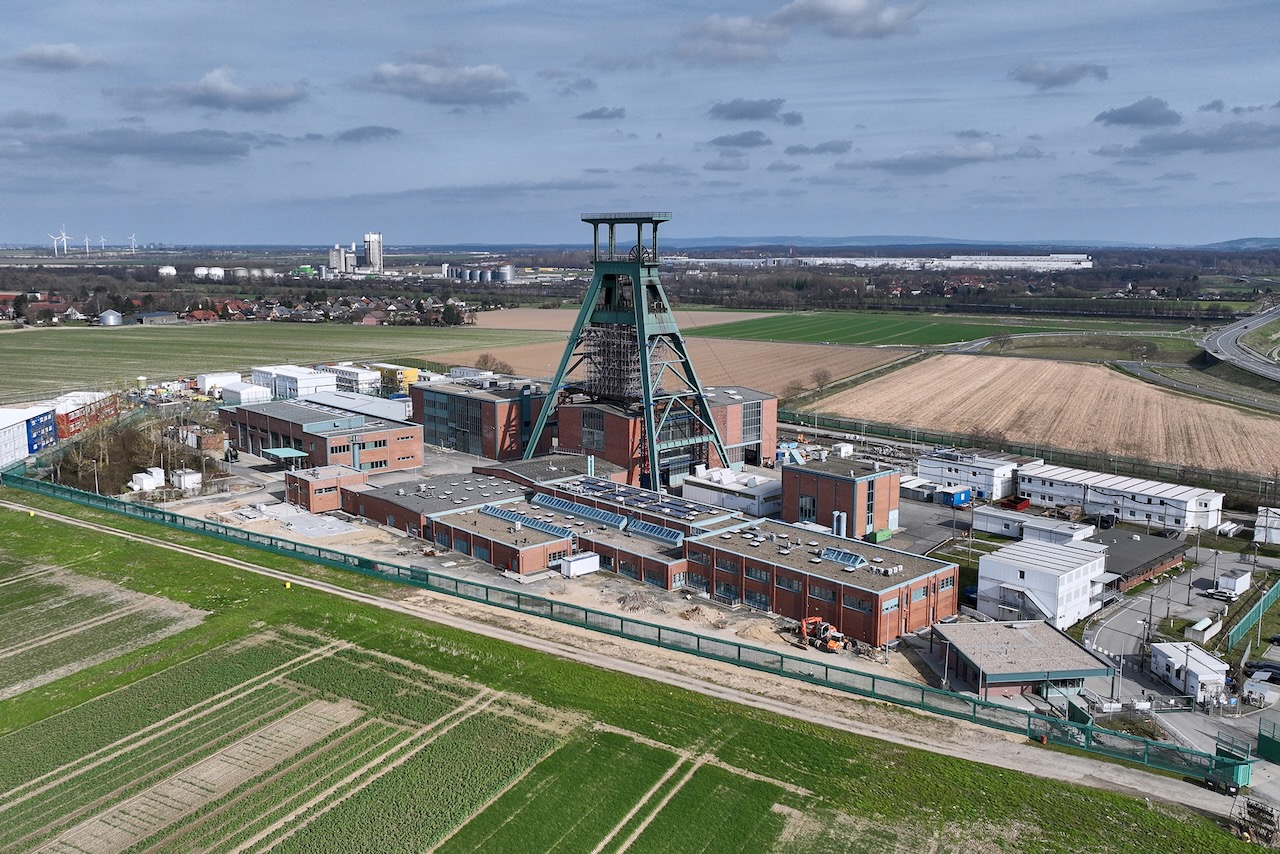
Jacobs has been appointed by Germany’s Bundesgesellschaft für Endlagerung (BGE) to provide project support for the Konrad Repository in Salzgitter, a low- and intermediate-level radioactive waste facility being developed within existing underground mining structures. The contract covers assessment of construction progress, validation of planning assumptions, schedule and cost plan reviews, and implementation of efficiency improvements under combined mining, nuclear and seismic regulatory constraints. Jacobs will align construction activities, timelines and cost structures with on-site conditions, drawing on experience from Sellafield and Belgian radioactive waste treatment and storage projects.
Sandvik Australia, New Zealand and Papua New Guinea sales area vice president Craig Johnston says Australia’s highly competitive mining market is driving demand for proven underground loaders and drills backed by strong aftermarket support and expanding digital and automation platforms. Johnston points to mine-wide automation architectures, data-driven fleet optimisation and remote monitoring as priorities, with Sandvik integrating these across existing equipment fleets rather than only new capital projects. For geotechnical and operations teams, the message is tighter linkage between equipment health data, production KPIs and long-term asset planning.
Adavale Resources has lifted total gold resources at its Parkes project in New South Wales from 115,000oz to 383,300oz in under 17 months through resource growth and strategic acquisitions centred on the London–Victoria deposit. The project remains at an early exploration stage, with multiple near-mine and regional targets still untested by systematic drilling, signalling substantial upside for further resource definition. For mine planners and geotechs, the rapid inventory increase materially changes potential project scale, pit shell scenarios and future drilling priorities.
BHP and Amazon have launched a first-of-its-kind pilot linking copper from BHP’s Escondida mine in Chile to Amazon’s data centre and infrastructure demand via Environmental Attribute Certificates (EACs) tied to specific copper concentrate and cathode production. The trial will track and trade EACs that quantify lower greenhouse gas emissions across defined segments of Escondida’s supply chain, rather than relying solely on mine-level averages. For miners and downstream buyers, this tests a mechanism to monetise low-carbon copper at batch level and could influence contract structures, certification, and reporting requirements.
Capricorn Metals has completed the Karlawinda expansion project in Western Australia on schedule, lifting the gold operation to its targeted steady-state throughput of 6.5 million tonnes per annum. Construction and installation of the upgraded processing infrastructure were executed over 12 months, followed by a two-week commissioning phase. Continuous ore processing has now commenced, signalling full utilisation of the expanded plant capacity and locking in higher mill throughput for the Karlawinda operation.
Brisbane will host the new Critical Metals for Critical Industries Cooperative Research Centre (CRC), based at the University of Queensland’s Brisbane City campus and initially targeting vanadium technologies. The CRC will link miners, processors, equipment suppliers, researchers and governments to fast‑track commercialisation of extraction, processing and downstream manufacturing technologies for critical metals supply chains. For geotechnical and mining engineers, this signals upcoming pilot‑scale projects, testwork and funding opportunities around vanadium deposits, tailings reprocessing and battery‑grade product specifications in Australia.
Nth Cycle has signed a binding 10-year offtake term sheet with Glencore worth an estimated $1 billion, securing 100% of black mass feedstock from Glencore’s US shredding network for Project SHIELD, its planned South Carolina battery materials refinery. The deal covers offtake of high-purity mixed hydroxide precipitate (nickel/cobalt MHP) and battery-grade lithium carbonate, and includes assessing an existing Glencore US site to accelerate construction alongside Nth Cycle’s 21,000-square-foot Fairfield, Ohio facility. Both parties will also evaluate deploying Nth Cycle’s portable ‘Oyster’ electrochemical refining system for black mass, copper and rare earth recovery in Europe and globally.
Military Metals has secured a C$100,000 Mineral Resource Development Fund grant from the Nova Scotia Department of Natural Resources to support a seven-hole, 1,750 m diamond drilling programme at the past-producing West Gore antimony-gold project in the Meguma camp. Drilling will test down-plunge extensions below historical mine workings and the Brook Vein stope, following historical intercepts up to 10.6 g/t gold and 3.4% antimony over 7.1 m. West Gore previously produced an estimated 7,761 t of 46% Sb concentrate and 7,149 oz gold but has seen only minor work since the 1960s.
Mining companies in Burkina Faso and Mali have built “mini armies” and effectively turned mine sites into “mini states” as central governments and local militaries lose control of territory, says George McLeod of Critical Risk Team. Operations are being maintained by focusing narrowly on secure logistics corridors for inbound supplies and outbound concentrate, allowing projects to function in what he calls a “complete and total power vacuum”. McLeod also expects China’s dominance in rare earths refining to erode within about three years as Australia, the US and Brazil commission new processing capacity and substitution technologies reduce demand.
Blue Moon Metals’ Springer project in Nevada returned a 7 metre interval grading 1.28% WO₃ and 0.01% Mo from 160 metres in surface hole NM-13, plus 24.25 metres at 0.53% WO₃ and 0.12% Mo in NM-44, from a relogging and re-assay campaign now 64% through 18,000 metres of historical core. The 4,560-hectare skarn project, with a historical 355,000 tons at 0.537% WO₃ and a 1,200 long ton/day mill built by General Electric, is being evaluated for restart in Q4 2027. US BLM approval for 13 new drill pads enables a planned 67,000-metre diamond drilling programme on public land, materially expanding step-out and infill options.
Barrick Mining, Equinox Gold, Hudbay Minerals and Royal Gold feature among TD Cowen’s 24 “Canada Best Ideas” picks, with catalysts centred on production growth, asset deals and valuation gaps of about 20–25% versus peers and large-cap North American miners. TD Cowen projects Barrick’s 2027 output at 3.7 million oz. gold and 225,000 tonnes copper with about $8 billion free cash flow and an IPO of North American assets targeted for early 2027, while Equinox’s Orla Mining acquisition is expected to lift gold production 40% to 1.27 million oz. and EBITDA 62% to $3.48 billion. Hudbay’s Cactus and Copper World projects are forecast to push copper production to roughly 333,000 tonnes by 2036, and Royal Gold is guided to 6.1% volume growth in 2027 from streams at Kansanshi, Platreef, Robertson and Pueblo Viejo.
Copper futures on Comex climbed 1.1% to $6.8370/lb (about $15,070/t), within 1% of their record settlement, as SHFE warehouse stocks fell 70% since June to 43,900 t and cash copper on the LME flipped into a $62/t backwardation, signalling acute near-term tightness. Cancelled LME warrants have risen to 122,150 t, leaving only 133,725 t available, while Comex now holds 696,204 t, about 69% of exchange-monitored copper, with New Orleans storage near full and another 100,000 t inbound. Supply risks remain elevated, with Grasberg and Kamoa-Kakula disruptions removing roughly 600,000 t from 2026 mine output and Sprott warning global production could contract for the first time since 2017.
Komatsu has commissioned its 1,000th autonomous ultra-class haul truck using the FrontRunner Autonomous Haulage System (AHS), signalling a mature, large-scale deployment of driverless haulage fleets across multiple mines. FrontRunner integrates high-precision GPS, obstacle detection radar and LiDAR with central fleet management to control truck speed, dump-point approach and interaction with manned equipment on complex haul networks. For mine planners and geotechnical teams, the scale of AHS adoption is pushing tighter road geometry tolerances, more consistent ramp grades and berm standards, and stricter separation of autonomous and conventional traffic.
Meridian Mining’s updated feasibility study for the Cabaçal gold-copper project in Mato Grosso more than doubles after-tax NPV to US$2.09 billion, assuming US$3,570/oz gold, US$5.03/lb copper and US$50.17/oz silver, with an IRR of 108% and an 11‑month payback on US$322 million initial capex. The staged open-pit plan is based on 56.04 million tonnes of proven and probable reserves grading 0.61 g/t gold and 0.35% copper, ramping plant throughput from 1.93 Mt/y to 4.5 Mt/y via a US$56 million expansion. Meridian forecasts first‑five‑year output averaging 183,500 gold‑equivalent oz/y at US$715/oz AISC, with installation licence approval and project financing still pending.
I-80 Gold’s latest feasibility study for the Granite Creek underground mine in Nevada triples measured and indicated resources to 3.73 million tonnes at 7.17 g/t (859,500 oz.) and defines initial reserves of 2.2 million tonnes at 7.87 g/t (556,500 oz.), but lifts life-of-mine all-in sustaining costs 42% to $2,273/oz. Total capital and closure costs rise to $145 million, including $83 million sustaining and $49 million for refurbishing the Lone Tree plant, which is expected online in late 2027. The 8.5-year plan targets 75,000 oz./year from 2028–32, with Granite Creek ore feeding the refurbished Lone Tree autoclave and forecast net cash flow of $238 million over that five-year period.
Vale is acquiring a 30% stake in Ligga S.A. for about $190 million, securing exclusive offtake rights to 100% of sinter feed from the Ferro Sul mine in Brazil’s Carajás region. The deal underpins an expansion to quadruple Ligga’s output from roughly 2 Mtpa to 8 Mtpa by mid-2028, with ore railed 10 km to the Carajás Railroad and exported via the Ponta da Madeira Maritime Terminal. Vale says the move adds high-quality volumes to its 330 Mtpa Brazilian iron ore portfolio with low capital intensity by leveraging existing Northern System logistics.
Value for Bravo Mining’s Luanga polymetallic project in Pará has risen to a post-tax NPV of $1.45 billion at an 8% discount rate, with a 35% IRR and two-year payback, after a new prefeasibility study added a Barcarena Export Processing Zone smelter to a 9.6‑year, 8.7 Mtpa open-pit operation. Pre-production capital climbs to about $785 million, but ZPE fiscal benefits cut smelter capex by an estimated $90 million and operating costs by $41.20/t, while Jameson Cell flotation lifts concentrate grade from 80 g/t to about 100 g/t PGM+Au. Proven and probable reserves of 86.7 Mt support forecast annual payable output of roughly 393,800 oz PGM+Au and 9,800 t nickel, plus 878,000 t sulphuric acid over the mine life.
Ok Tedi Mining has commissioned two ArcSAR Neo slope stability monitoring radar systems from IDS GeoRadar at its Papua New Guinea copper-gold operation, becoming the first mine globally to deploy the new platform. The ArcSAR Neo units provide continuous, high-resolution displacement monitoring of pit walls, using arc-scanning radar and advanced processing to detect millimetre-scale movements in real time. For geotechnical teams, the dual-system deployment increases spatial coverage and redundancy for critical slope risk management in a high-rainfall, structurally complex open pit.
BME, an Omnia Holdings company, has developed a Portable Training Unit to give underground blasting and explosives operators realistic, hands-on training rather than relying solely on classroom instruction. The mobile platform is designed to simulate field procedures and equipment handling so mines can build operator competency, reduce misfires and handling errors, and better protect production assets. For geotechnical and production engineers, this points to closer integration of explosives training with ground control plans and asset integrity management.
OreNova Engineering is deploying proprietary AI-based design tools to accelerate the definitive feasibility study for Horizon Gold’s Gum Creek project in Western Australia, targeting faster engineering of the mineral processing plant. The Perth-based firm is using automated process modelling and plant layout optimisation to compress design cycles that traditionally take months into weeks, while iterating multiple comminution and gold recovery flowsheets. For project engineers, this points to shorter DFS schedules, earlier capex definition and the ability to rapidly compare alternative plant configurations under varying throughput and ore characteristics.
Metso has signed its largest analyser Life Cycle Services (LCS) agreement to date, a five-year contract with a major South American copper producer covering performance-based support for on-stream analysers. The deal centres on an outcome-based model, with Metso responsible for maintaining analyser availability and measurement accuracy across the concentrator to stabilise grade control and process optimisation. For plant and maintenance engineers, it signals deeper OEM involvement in long-term condition monitoring, remote diagnostics and KPI-linked service for critical assay instrumentation.
Globe 24-7 has launched Globe Trust 24-7, a joint venture with Guinea-based Trust Africa, to expand mining recruitment and workforce solutions across Guinea and the wider West African belt. The JV targets operators in gold, bauxite and iron ore projects seeking local and expatriate technical talent in geology, mine planning, processing and HSE. For project owners, this signals easier access to regionally based recruiters familiar with OH&S regimes, francophone labour markets and rapid mobilisation for new pits, plant expansions and feasibility teams.
Wabtec Corporation has secured a long-term services agreement worth more than $700 million with La Compagnie du TransGuinéen (CTG) to support a new fleet of Evolution Series locomotives on the Simandou iron ore rail corridor in Guinea. Combined with CTG’s 2024 locomotive orders, Wabtec’s total Simandou-related contract value now exceeds $1.2 billion, its largest services package in Africa. The deal signals long-horizon OEM support for heavy-haul rail operations that will underpin bulk ore export logistics from the greenfield Simandou development.