Geomechanics.io

  • Free Tools
Sign UpLog In

Geomechanics.io

Geomechanics, Streamlined.

© 2026 Geomechanics.io. All rights reserved.

Geomechanics.io

CMRR-ioGEODB-ioHYDROGEO-ioQCDB-ioFree Tools & CalculatorsBlogLatest Industry News

Industries

MiningConstructionTunnelling

Company

Terms of UsePrivacy PolicyLinkedIn
    AllGeotechnicalMiningInfrastructureMaterialsHazardsEnvironmentalSoftwarePolicy
    Failure
    Safety
    Projects

    Whitchurch canal breach: failure mechanisms and monitoring lessons for engineers

    December 23, 2025|

    Reviewed by Tom Sullivan

    Whitchurch canal breach: failure mechanisms and monitoring lessons for engineers

    First reported on New Civil Engineer

    30 Second Briefing

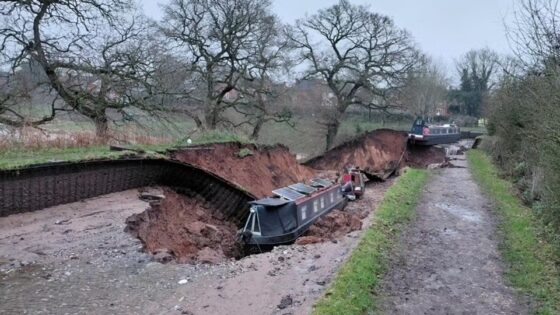
    A catastrophic breach on the Llangollen Canal near New Mills Lift Bridge, Whitchurch has drained a long pound and damaged the embankment, despite recent routine inspections reporting no visible defects. Engineers from the Canal & River Trust are now investigating potential failure mechanisms, including internal erosion, leakage paths and historic construction weaknesses in the canal lining and embankment core. The incident raises immediate questions over current visual inspection regimes for ageing UK canal earthworks and whether more frequent intrusive or remote condition monitoring is needed on high-consequence reaches.

    Technical Brief

    • Failure was sudden during normal operation, with no preceding drawdown, overtopping or reported slope movement.
    • Investigation is expected to focus on embankment zoning, historic puddle clay lining continuity and any previous repairs.
    • Engineers will likely review past inspection records, defect logs and water level data to reconstruct pre-failure behaviour.
    • Short-term safety actions include isolating the affected pound, restricting navigation and securing public access to the breach.
    • Ongoing monitoring will need to track residual embankment stability, seepage paths and any progressive retrogression of the breach.
    • Incident is likely to prompt reassessment of UK canal earthwork risk categorisation and inspection methods for high-consequence reaches.

    Our Take

    Within the 14 recent Geotechnical stories in our coverage, canal and river embankment failures like the Llangollen Canal incident are relatively rare compared with highway and rail earthwork issues, suggesting water-retaining linear assets may be under-represented in current inspection and risk-modelling practice.

    The Failure and Safety tags here align with several other pieces in our database where assets passed routine inspections shortly before an incident, which is likely to fuel interest in more performance-based monitoring (e.g. pore pressure, deformation) rather than relying mainly on visual condition ratings.

    For a heritage navigation such as the Llangollen Canal near Whitchurch, unplanned breaches can rapidly escalate into third-party damage and navigation closures, so operators on similar Projects are likely to face pressure from insurers and regulators to re-examine design flood assumptions and internal erosion controls on older embankments.

    Geotechnical Software for Modern Teams

    Centralise site data, logs, and lab results with GEODB-io, CMRR-io, and HYDROGEO-io.

    No credit card required.

    • Save and export unlimited calculations
    • Advanced data visualisation
    • Generate professional PDF reports
    • Cloud storage for all your projects

    Prepared by collating external sources, AI-assisted tools, and Geomechanics.io’s proprietary mining database, then reviewed for technical accuracy & edited by our geotechnical team.

    Related Articles
    Europe’s deepest offshore breakwater: geotechnical design lessons for engineers
    Geotechnical
    1 day ago

    Europe’s deepest offshore breakwater: geotechnical design lessons for engineers

    Construction of a 6km offshore breakwater with Europe’s deepest foundations is pushing marine geotechnical limits, with caissons and foundation elements installed in exceptionally deep water using heavy-lift vessels and precision positioning systems. Complex offsite fabrication of large concrete units, likely in a dedicated casting yard with slipform or match-cast techniques, is being coordinated with narrow marine weather windows and high-capacity barges to maintain programme. For designers and contractors, the project stresses accurate seabed characterisation, robust scour protection detailing and tight control of tolerances during submerged placement.

    Long Baseline Neutrino Facility caverns: geotechnical design notes for engineers
    Geotechnical
    6 days ago

    Long Baseline Neutrino Facility caverns: geotechnical design notes for engineers

    Excavation is under way 1.5km below ground at the Long Baseline Neutrino Facility in South Dakota to create three caverns, each roughly cathedral-sized, to house the Deep Underground Neutrino Experiment’s liquid-argon detectors. The 1,300km-long beamline from Fermilab to the former Homestake gold mine demands tight control of rock mass behaviour, with extensive pre-grouting, cable bolting and shotcrete linings in complex, stressed Precambrian formations. Construction sequencing, spoil handling through deep shafts and long-term groundwater management are central geotechnical risks for the multi-year programme.

    Aging behaviour of helical anchors and piles: design and safety notes for engineers
    Geotechnical
    7 days ago

    Aging behaviour of helical anchors and piles: design and safety notes for engineers

    Immediate load capacity of helical anchors and piles at installation is being challenged by data showing significant “aging” effects, with shaft resistance and overall capacity increasing measurably over days to months in clays and some sands. The discussion contrasts torque-correlated design methods with time-dependent capacity gains, referencing field load tests where post-installation capacity growth alters factor-of-safety assumptions and serviceability performance. For practitioners, the key issue is whether to rely solely on installation torque or to incorporate waiting periods and ageing factors into design for temporary works, tiebacks and lightly loaded foundations.

    Related Industries & Products

    Construction

    Quality control software for construction companies with material testing, batch tracking, and compliance management.

    Mining

    Geotechnical software solutions for mining operations including CMRR analysis, hydrogeological testing, and data management.

    QCDB-io

    Comprehensive quality control database for manufacturing, tunnelling, and civil construction with UCS testing, PSD analysis, and grout mix design management.