Geomechanics.io

  • Free Tools
Sign UpLog In
AllGeotechnicalMiningInfrastructureMaterialsHazardsEnvironmentalSoftwarePolicy

Geomechanics.io

Geomechanics, Streamlined.

© 2026 Geomechanics.io. All rights reserved.

Geomechanics.io

CMRR-ioGEODB-ioHYDROGEO-ioQCDB-ioFree Tools & CalculatorsBlogLatest Industry News

Industries

MiningConstructionTunnelling

Company

Terms of UsePrivacy PolicyLinkedIn
    Failure
    Safety
    Projects

    Shap lineside monitoring warning: slope stability lessons for rail engineers

    December 22, 2025|

    Reviewed by Joe Ashwell

    Shap lineside monitoring warning: slope stability lessons for rail engineers

    First reported on New Civil Engineer

    30 Second Briefing

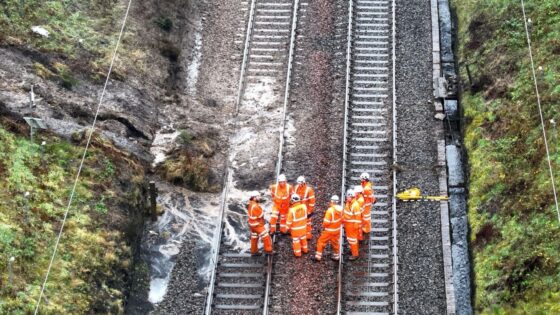
    Lineside monitoring systems on parts of Britain’s rail network may fail to detect embankment or cutting slope movements during extreme rainfall, the Rail Accident Investigation Branch has warned following the 3 November passenger train derailment near Shap, Cumbria. The warning concerns remote condition monitoring equipment installed to trigger alerts for ground instability, which did not prevent the derailment. Geotechnical and asset engineers are being urged to review sensor siting, trigger thresholds and system performance in severe weather, particularly on high-risk slopes.

    Technical Brief

    • Inspectors are reviewing how monitoring hardware is mounted relative to potential slip planes and failure geometries.
    • Trigger logic and alarm hierarchies are being examined for masking, suppression or filtering of transient instability signals.
    • Monitoring resilience in severe weather is being checked, including power supply robustness and communications redundancy.
    • Remedial options under consideration include relocating sensors, adding independent geotechnical instruments and revising threshold settings.

    Our Take

    RAIB’s warning on lineside slope monitoring at Shap sits alongside its recent findings on the Gloucestershire heritage footbridge strike, signalling that UK rail risk exposure is currently split between geotechnical instability and worksite/plant interface errors rather than a single dominant failure mode.

    With Network Rail named in the related Shap investigation summary, this incident increases pressure on British route asset managers to verify whether existing slope monitoring specifications are adequate for rapid failures in high‑rainfall corridors such as Cumbria, rather than relying on generic national standards.

    Among the 21 Hazards stories in our coverage, RAIB appears repeatedly, suggesting that its recommendations are now a primary driver for safety‑critical changes on UK rail projects, especially where legacy infrastructure and modern monitoring systems intersect.

    Geotechnical Software for Modern Teams

    Centralise site data, logs, and lab results with GEODB-io, CMRR-io, and HYDROGEO-io.

    No credit card required.

    • Save and export unlimited calculations
    • Advanced data visualisation
    • Generate professional PDF reports
    • Cloud storage for all your projects

    Prepared by collating external sources, AI-assisted tools, and Geomechanics.io’s proprietary mining database, then reviewed for technical accuracy & edited by our geotechnical team.

    Related Articles

    Melbourne sinkhole investigations: geotechnical lessons for tunnel project teams
    Hazards
    in 5 months

    Melbourne sinkhole investigations: geotechnical lessons for tunnel project teams

    A sinkhole roughly 8–10 m wide and several metres deep has opened on the AJ Burkitt Reserve sporting oval in Heidelberg, directly adjacent to the North East Link tunnel alignment in Melbourne’s northeast. Victorian Infrastructure Delivery Authority has confirmed the “surface hole” is in the vicinity of active tunnelling operations, leading to a work pause while engineers and emergency crews carry out geotechnical investigations and monitoring. No injuries or structural damage have been reported, but the area remains fully cordoned off pending cause determination and stability assessment.

    Spain retaining wall collapse derailment: failure lessons for rail engineers
    Hazards
    2 days ago

    Spain retaining wall collapse derailment: failure lessons for rail engineers

    A commuter train derailed in Gelida, near Barcelona, on 20 January after striking a collapsed retaining wall that had fallen onto the track, killing the driver and injuring 37 passengers. The incident, Spain’s second fatal rail accident in a week, occurred on a section of line with trackside earth-retaining structures, raising immediate questions over wall design, drainage, inspection frequency and slope stability under recent weather conditions. For civil and geotechnical engineers, failure mode identification and rapid condition assessment of similar retaining systems on active corridors will be a priority.

    Thailand crane collapse on passenger train: engineering lessons for rail projects
    Hazards
    10 days ago

    Thailand crane collapse on passenger train: engineering lessons for rail projects

    A construction crane collapsed onto a moving passenger train in northeastern Thailand on Wednesday morning, killing at least 32 people and injuring more than 60. The crane, operating on an adjacent construction site, failed and toppled across active railway tracks, striking multiple carriages at speed and causing extensive structural damage and derailment. Investigators are expected to focus on crane foundation design, ground conditions near the rail corridor, lift planning, exclusion zones and compliance with Thai standards for plant operating beside live transport infrastructure.

    Related Industries & Products

    Mining

    Geotechnical software solutions for mining operations including CMRR analysis, hydrogeological testing, and data management.

    Construction

    Quality control software for construction companies with material testing, batch tracking, and compliance management.

    CMRR-io

    Streamline coal mine roof stability assessments with our cloud-based CMRR software featuring automated calculations, multi-scenario analysis, and collaborative workflows.

    HYDROGEO-io

    Comprehensive hydrogeological testing platform for managing, analysing, and reporting on packer tests, lugeon values, and hydraulic conductivity assessments.

    GEODB-io

    Centralised geotechnical data management solution for storing, accessing, and analysing all your site investigation and material testing data.