Spain retaining wall collapse derailment: failure lessons for rail engineers
Reviewed by Tom Sullivan
First reported on New Civil Engineer
30 Second Briefing
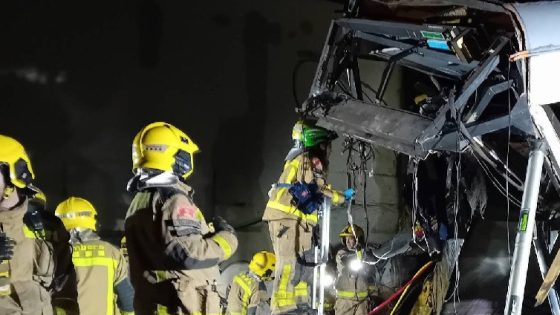
A commuter train derailed in Gelida, near Barcelona, on 20 January after striking a collapsed retaining wall that had fallen onto the track, killing the driver and injuring 37 passengers. The incident, Spain’s second fatal rail accident in a week, occurred on a section of line with trackside earth-retaining structures, raising immediate questions over wall design, drainage, inspection frequency and slope stability under recent weather conditions. For civil and geotechnical engineers, failure mode identification and rapid condition assessment of similar retaining systems on active corridors will be a priority.
Technical Brief
- Failure mechanism likely involved loss of retaining wall stability, with forensic focus on drainage, backfill and bearing.
- Investigation will need detailed wall type identification (gravity, cantilever, crib, etc.) and construction records review.
- Geotechnical back‑analysis should compare as‑built geometry and soil parameters against original design factors of safety.
- Targeted boreholes, trial pits and non‑destructive testing can characterise foundation conditions and detect hidden degradation.
- Monitoring options for similar assets include inclinometers, crack gauges, tilt sensors and periodic LiDAR trackside surveys.
- Remediation on comparable walls may require relieving structures, improved toe support, retrofitted anchors or reconstructed sections.
- Safety review is expected to examine inspection intervals, defect classification thresholds and emergency line‑closure protocols.
- For other rail corridors, systematic risk ranking of retaining walls under extreme weather loading becomes a priority task.
Our Take
Among the 32 Hazards stories in our coverage, very few involve retaining wall collapses onto active rail lines, which signals that the Gelida incident will likely be scrutinised as a geotechnical and asset-management failure rather than a routine operational safety lapse in Spain.
With 37 injured passengers and one fatality, this Spain event sits at the higher-consequence end of recent Failure-tagged pieces, which may push Spanish rail and civil authorities around Barcelona to revisit inspection regimes for older earth-retaining structures near transport corridors.
Given that many Safety- and Projects-tagged items in our database now reference AI or artificial intelligence for condition monitoring, the collapse near Gelida underscores the potential value of deploying sensor- and AI-based early warning on retaining walls adjacent to busy passenger routes.
Prepared by collating external sources, AI-assisted tools, and Geomechanics.io’s proprietary mining database, then reviewed for technical accuracy & edited by our geotechnical team.
Related Articles

Related Industries & Products
Construction
Quality control software for construction companies with material testing, batch tracking, and compliance management.
Mining
Geotechnical software solutions for mining operations including CMRR analysis, hydrogeological testing, and data management.
QCDB-io
Comprehensive quality control database for manufacturing, tunnelling, and civil construction with UCS testing, PSD analysis, and grout mix design management.