Geomechanics.io

  • Free Tools
Sign UpLog In

Geomechanics.io

Geomechanics, Streamlined.

© 2026 Geomechanics.io. All rights reserved.

Geomechanics.io

CMRR-ioGEODB-ioHYDROGEO-ioQCDB-ioFree Tools & CalculatorsBlogLatest Industry News

Industries

MiningConstructionTunnelling

Company

Terms of UsePrivacy PolicyLinkedIn
    Projects
    Failure
    Safety

    Llangollen Canal embankment failure: breach mechanics and lessons for engineers

    December 22, 2025|

    Reviewed by Joe Ashwell

    Llangollen Canal embankment failure: breach mechanics and lessons for engineers

    First reported on Geoengineer.org – News

    30 Second Briefing

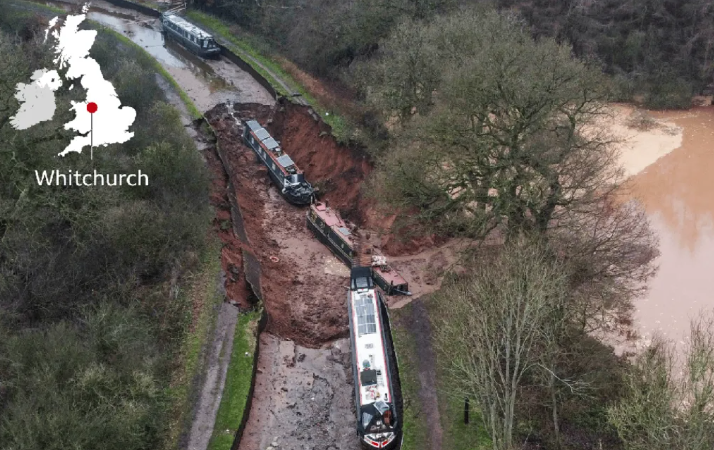
    A man-made embankment on the Llangollen Canal near Whitchurch, Shropshire, failed in the early hours of Monday, creating a large breach that rapidly drained a several‑kilometre pound and triggered a major incident response. The failure occurred on a raised canal section over low-lying farmland, with water overtopping and eroding the embankment before a full breach developed, flooding adjacent fields and damaging access tracks. Canal & River Trust engineers have isolated the affected reach with stop planks and are assessing embankment stability, seepage paths and repair options under constrained access conditions.

    Technical Brief

    • Incident underlines the need for systematic risk-based inspection of ageing canal embankments, especially raised sections over third-party land.

    Our Take

    Within our 22 Hazards stories, the Llangollen Canal failure stands out as one of the few UK civil infrastructure incidents, whereas most hazards coverage is skewed towards mine tailings and pit wall stability rather than navigation embankments.

    For operators in Shropshire and wider UK waterway infrastructure, this type of canal embankment failure highlights similar geotechnical risk modes to older flood embankments and tailings dams, especially where historic earthworks pre-date modern design standards and surveillance practices.

    Given the ‘Projects / Failure / Safety’ tagging, asset owners along the Llangollen Canal corridor may face closer scrutiny of inspection regimes, seepage monitoring, and emergency drawdown provisions, aligning them more with the risk management expectations already common in major mining earthworks projects in our database.

    Geotechnical Software for Modern Teams

    Centralise site data, logs, and lab results with GEODB-io, CMRR-io, and HYDROGEO-io.

    No credit card required.

    • Save and export unlimited calculations
    • Advanced data visualisation
    • Generate professional PDF reports
    • Cloud storage for all your projects

    Prepared by collating external sources, AI-assisted tools, and Geomechanics.io’s proprietary mining database, then reviewed for technical accuracy & edited by our geotechnical team.

    Related Articles

    Melbourne sinkhole investigations: geotechnical lessons for tunnel project teams
    Hazards
    in 5 months

    Melbourne sinkhole investigations: geotechnical lessons for tunnel project teams

    A sinkhole roughly 8–10 m wide and several metres deep has opened on the AJ Burkitt Reserve sporting oval in Heidelberg, directly adjacent to the North East Link tunnel alignment in Melbourne’s northeast. Victorian Infrastructure Delivery Authority has confirmed the “surface hole” is in the vicinity of active tunnelling operations, leading to a work pause while engineers and emergency crews carry out geotechnical investigations and monitoring. No injuries or structural damage have been reported, but the area remains fully cordoned off pending cause determination and stability assessment.

    Spain retaining wall collapse derailment: failure lessons for rail engineers
    Hazards
    2 days ago

    Spain retaining wall collapse derailment: failure lessons for rail engineers

    A commuter train derailed in Gelida, near Barcelona, on 20 January after striking a collapsed retaining wall that had fallen onto the track, killing the driver and injuring 37 passengers. The incident, Spain’s second fatal rail accident in a week, occurred on a section of line with trackside earth-retaining structures, raising immediate questions over wall design, drainage, inspection frequency and slope stability under recent weather conditions. For civil and geotechnical engineers, failure mode identification and rapid condition assessment of similar retaining systems on active corridors will be a priority.

    Thailand crane collapse on passenger train: engineering lessons for rail projects
    Hazards
    10 days ago

    Thailand crane collapse on passenger train: engineering lessons for rail projects

    A construction crane collapsed onto a moving passenger train in northeastern Thailand on Wednesday morning, killing at least 32 people and injuring more than 60. The crane, operating on an adjacent construction site, failed and toppled across active railway tracks, striking multiple carriages at speed and causing extensive structural damage and derailment. Investigators are expected to focus on crane foundation design, ground conditions near the rail corridor, lift planning, exclusion zones and compliance with Thai standards for plant operating beside live transport infrastructure.

    Related Industries & Products

    Mining

    Geotechnical software solutions for mining operations including CMRR analysis, hydrogeological testing, and data management.

    Construction

    Quality control software for construction companies with material testing, batch tracking, and compliance management.

    CMRR-io

    Streamline coal mine roof stability assessments with our cloud-based CMRR software featuring automated calculations, multi-scenario analysis, and collaborative workflows.

    HYDROGEO-io

    Comprehensive hydrogeological testing platform for managing, analysing, and reporting on packer tests, lugeon values, and hydraulic conductivity assessments.

    GEODB-io

    Centralised geotechnical data management solution for storing, accessing, and analysing all your site investigation and material testing data.

    AllGeotechnicalMiningInfrastructureMaterialsHazardsEnvironmentalSoftwarePolicy