Geomechanics.io

  • Free Tools
Sign UpLog In

Geomechanics.io

Geomechanics, Streamlined.

© 2026 Geomechanics.io. All rights reserved.

Geomechanics.io

CMRR-ioGEODB-ioHYDROGEO-ioQCDB-ioFree Tools & CalculatorsBlogLatest Industry News

Industries

MiningConstructionTunnelling

Company

Terms of UsePrivacy PolicyLinkedIn
    Projects
    Failure
    Safety

    Khanh Le Pass slope failure: geotechnical lessons and design notes for engineers

    November 16, 2025|

    Reviewed by Joe Ashwell

    Khanh Le Pass slope failure: geotechnical lessons and design notes for engineers

    First reported on Geoengineer.org – News

    30 Second Briefing

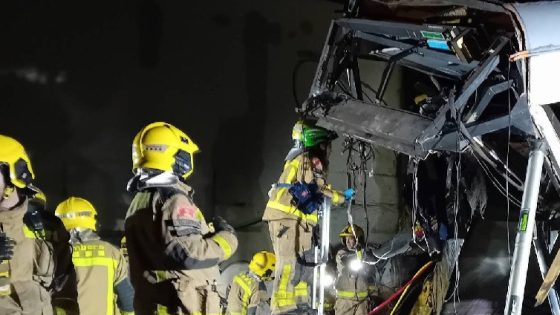
    A major landslide on the 33‑kilometre Khanh Le Pass in central Viet Nam buried a passenger bus late on Sunday, killing six people and injuring 19. The mountain road, cut into steep terrain with deeply weathered residual soils, is already known for frequent rockfalls and debris slides during intense rainfall. The incident highlights urgent needs for detailed slope stability assessment, improved drainage, and engineered protection measures such as retaining structures, rockfall barriers, and real‑time monitoring on this and similar high‑risk corridors.

    Technical Brief

    • Investigation will need detailed geomorphic mapping, boreholes, piezometers and back‑analysis of shear strength along the failure surface.
    • Remediation options include catch benches, reinforced earth or retaining walls, and rockfall/debris flow barriers at known chutes.
    • Continuous monitoring could combine rainfall thresholds, slope inclinometers and CCTV to trigger automatic road closures and diversions.
    • For similar mountain passes, codified hazard zoning and mandatory pre‑monsoon slope inspections would materially tighten road safety management.

    Our Take

    Among the several Hazards stories in our coverage, very few involve non-mining infrastructure in Southeast Asia, so this failure on the 33 km Khanh Le pass road highlights that geohazard exposure for transport corridors in central Vietnam is comparatively under-documented relative to mine slopes and tailings facilities.

    The combination of six fatalities and 19 injuries on a mountain road in central Vietnam suggests that road alignment and cut-slope design on similar passes will likely face closer scrutiny from both transport and mining geotechnical teams, particularly where haulage routes share geomorphological conditions with public highways.

    With 26 tag-matched pieces under Projects/Failure/Safety, most recent failures in our database are tied to active construction or extraction sites; an event on an existing pass like Khanh Le signals that long-term slope monitoring and retrofitting of legacy cuts may now attract more attention than greenfield design alone in comparable terrain.

    Geotechnical Software for Modern Teams

    Centralise site data, logs, and lab results with GEODB-io, CMRR-io, and HYDROGEO-io.

    No credit card required.

    • Save and export unlimited calculations
    • Advanced data visualisation
    • Generate professional PDF reports
    • Cloud storage for all your projects

    Prepared by collating external sources, AI-assisted tools, and Geomechanics.io’s proprietary mining database, then reviewed for technical accuracy & edited by our geotechnical team.

    Related Articles

    Melbourne sinkhole investigations: geotechnical lessons for tunnel project teams
    Hazards
    in 5 months

    Melbourne sinkhole investigations: geotechnical lessons for tunnel project teams

    A sinkhole roughly 8–10 m wide and several metres deep has opened on the AJ Burkitt Reserve sporting oval in Heidelberg, directly adjacent to the North East Link tunnel alignment in Melbourne’s northeast. Victorian Infrastructure Delivery Authority has confirmed the “surface hole” is in the vicinity of active tunnelling operations, leading to a work pause while engineers and emergency crews carry out geotechnical investigations and monitoring. No injuries or structural damage have been reported, but the area remains fully cordoned off pending cause determination and stability assessment.

    Spain retaining wall collapse derailment: failure lessons for rail engineers
    Hazards
    2 days ago

    Spain retaining wall collapse derailment: failure lessons for rail engineers

    A commuter train derailed in Gelida, near Barcelona, on 20 January after striking a collapsed retaining wall that had fallen onto the track, killing the driver and injuring 37 passengers. The incident, Spain’s second fatal rail accident in a week, occurred on a section of line with trackside earth-retaining structures, raising immediate questions over wall design, drainage, inspection frequency and slope stability under recent weather conditions. For civil and geotechnical engineers, failure mode identification and rapid condition assessment of similar retaining systems on active corridors will be a priority.

    Thailand crane collapse on passenger train: engineering lessons for rail projects
    Hazards
    10 days ago

    Thailand crane collapse on passenger train: engineering lessons for rail projects

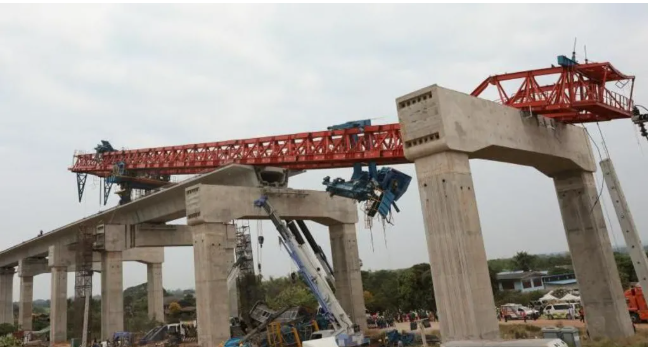
    A construction crane collapsed onto a moving passenger train in northeastern Thailand on Wednesday morning, killing at least 32 people and injuring more than 60. The crane, operating on an adjacent construction site, failed and toppled across active railway tracks, striking multiple carriages at speed and causing extensive structural damage and derailment. Investigators are expected to focus on crane foundation design, ground conditions near the rail corridor, lift planning, exclusion zones and compliance with Thai standards for plant operating beside live transport infrastructure.

    Related Industries & Products

    Mining

    Geotechnical software solutions for mining operations including CMRR analysis, hydrogeological testing, and data management.

    Construction

    Quality control software for construction companies with material testing, batch tracking, and compliance management.

    CMRR-io

    Streamline coal mine roof stability assessments with our cloud-based CMRR software featuring automated calculations, multi-scenario analysis, and collaborative workflows.

    HYDROGEO-io

    Comprehensive hydrogeological testing platform for managing, analysing, and reporting on packer tests, lugeon values, and hydraulic conductivity assessments.

    GEODB-io

    Centralised geotechnical data management solution for storing, accessing, and analysing all your site investigation and material testing data.

    AllGeotechnicalMiningInfrastructureMaterialsHazardsEnvironmentalSoftwarePolicy