Geomechanics.io

  • Free Tools
Sign UpLog In

Geomechanics.io

Geomechanics, Streamlined.

© 2026 Geomechanics.io. All rights reserved.

Geomechanics.io

CMRR-ioGEODB-ioHYDROGEO-ioQCDB-ioFree Tools & CalculatorsBlogLatest Industry News

Industries

MiningConstructionTunnelling

Company

Terms of UsePrivacy PolicyLinkedIn
    AllGeotechnicalMiningInfrastructureMaterialsHazardsEnvironmentalSoftwarePolicy
    Projects
    Safety
    Sustainability

    Bateman Dam resilience upgrades and Fleming Award: key lessons for dam engineers

    January 19, 2026|

    Reviewed by Joe Ashwell

    Bateman Dam resilience upgrades and Fleming Award: key lessons for dam engineers

    First reported on New Civil Engineer

    30 Second Briefing

    A collaborative project to maintain the Victorian Bateman Dam has secured the 2025 Fleming Award for excellence in geotechnical engineering. The team focused on improving dam resilience, likely involving upgrades to the embankment, foundation seepage control and spillway performance to meet current reservoir safety standards for extreme flood and seismic loading. For practitioners, the award signals continued industry emphasis on extending the life of ageing UK dams through targeted ground engineering and risk-based asset management rather than full replacement.

    Technical Brief

    • Monitoring and inspection regimes for the upgraded dam are expected to be central to the safety justification.

    Our Take

    Within the 19 Geotechnical stories in our database, UK dam and reservoir pieces like the Victorian Bateman Dam item are relatively few compared with slope and tunnelling coverage, signalling that award-winning retrofit work on legacy water assets is still a niche but visible topic.

    Safety-tagged UK infrastructure articles in our coverage increasingly link resilience upgrades to climate adaptation, so the Victorian Bateman Dam work is likely to be read by practitioners as a reference case for retrofitting older embankment dams rather than relying solely on new-build flood storage schemes.

    Because this is a UK project framed under Sustainability as well as Safety, it aligns with a small cluster of pieces where long-lived civil assets are being upgraded to meet modern risk standards without full replacement, a pattern that can influence how owners justify lifecycle investment in other historic dams and reservoirs.

    Geotechnical Software for Modern Teams

    Centralise site data, logs, and lab results with GEODB-io, CMRR-io, and HYDROGEO-io.

    No credit card required.

    • Save and export unlimited calculations
    • Advanced data visualisation
    • Generate professional PDF reports
    • Cloud storage for all your projects

    Prepared by collating external sources, AI-assisted tools, and Geomechanics.io’s proprietary mining database, then reviewed for technical accuracy & edited by our geotechnical team.

    Related Articles
    BGS UK ground investigation data service: design and risk notes for engineers
    Geotechnical
    4 days ago

    BGS UK ground investigation data service: design and risk notes for engineers

    The British Geological Survey is advancing a national geotechnical data service to collate UK ground investigation records into a single, standardised digital platform for project teams. By aggregating borehole logs, in situ test results and laboratory data from multiple legacy sources, the system aims to give designers earlier visibility of variable strata, groundwater conditions and historical contamination. For geotechnical and civil engineers, this could reduce duplicate site investigations, refine ground models at concept stage and improve risk pricing for foundations, earthworks and underground structures.

    Amids South 93m bridge: design lessons on weak ground for geotechnical engineers
    Geotechnical
    6 days ago

    Amids South 93m bridge: design lessons on weak ground for geotechnical engineers

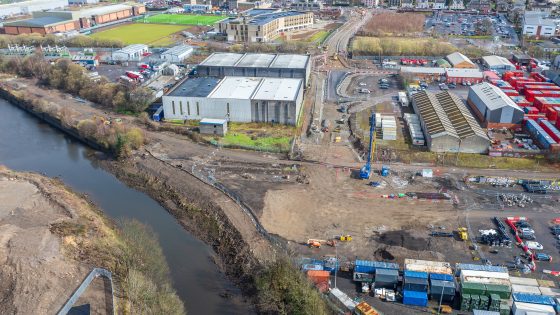
    A 93m-long bridge over the White Cart Water forms the core of the Amids South transport scheme, linking an existing industrial area to Paisley town centre and Glasgow Airport. Poor ground conditions along the river corridor drove a redesign of the substructure, with foundations and pier locations adjusted to avoid weak strata and reduce settlement risk. The scheme’s experience will interest geotechnical and bridge engineers dealing with soft alluvium and variable bearing capacity on constrained urban river crossings.

    Gary L. Seider P.E.: helical foundation design lessons for ground engineers
    Geotechnical
    8 days ago

    Gary L. Seider P.E.: helical foundation design lessons for ground engineers

    Gary L. Seider, P.E., is retiring after nearly 40 years with A.B. Chance, where he was instrumental in developing helical pile and anchor systems that became core to Hubbell’s foundation solutions portfolio after its 1994 acquisition. His work helped formalise design methodologies, installation torque–capacity correlations and training standards for contractors and engineers using screw anchors in transmission, distribution and commercial foundation projects. Seider’s legacy is a mature, codified helical foundation practice that many US geotechnical and structural engineers now treat as a routine design option.

    Related Industries & Products

    Construction

    Quality control software for construction companies with material testing, batch tracking, and compliance management.

    Tunnelling

    Specialised solutions for tunnelling projects including grout mix design, hydrogeological analysis, and quality control.

    GEODB-io

    Centralised geotechnical data management solution for storing, accessing, and analysing all your site investigation and material testing data.

    QCDB-io

    Comprehensive quality control database for manufacturing, tunnelling, and civil construction with UCS testing, PSD analysis, and grout mix design management.