Southbound again: Antarctic Discovery Building and causeway design notes for engineers
Reviewed by Joe Ashwell
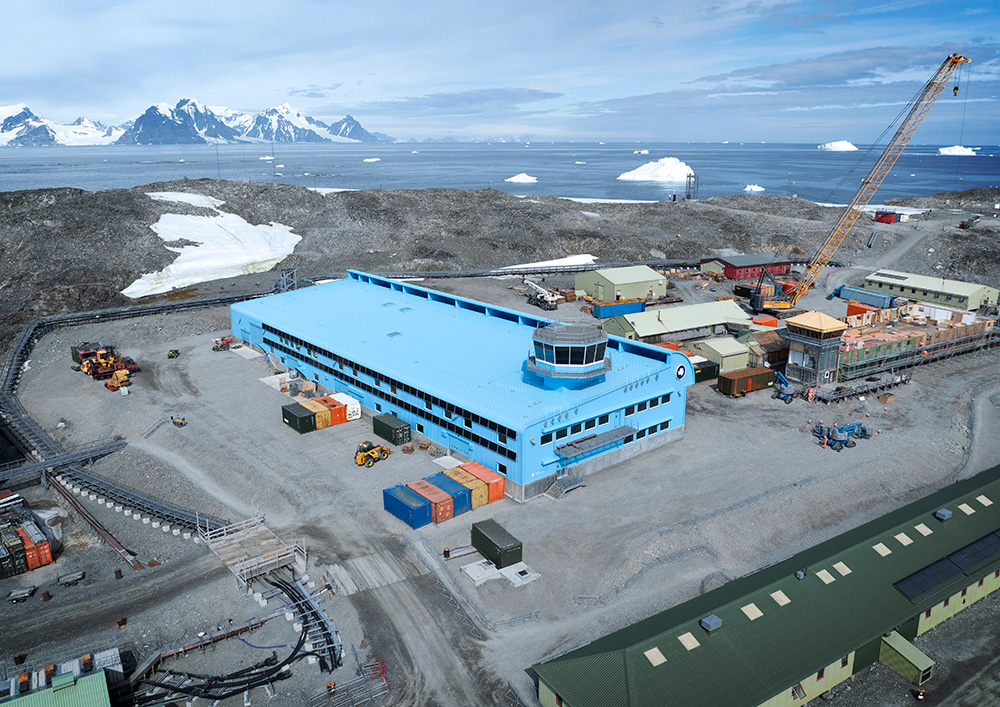
First reported on The Construction Index
30 Second Briefing
The British Antarctic Survey’s £100m Discovery Building at Rothera Research Station has been completed on time and budget, centralising field prep, storage, offices, training, medical and welfare facilities under one BMS-controlled roof designed for -22°C to +15°C conditions and targeting a 25% cut in station carbon emissions. Six redundant buildings are being deconstructed piece-by-piece, with cladding and other materials reused on site and waste containerised for controlled removal. Separately, Southbay Civil Engineering’s new 240m replacement causeway at Port Stanley, Falkland Islands, will use an inner rock core, outer rock armour and a heavy steel ramp, with local labour and materials.
Technical Brief
- Construction windows at Rothera are constrained to November–May, driving highly compressed seasonal work sequencing.
- A building management system actively modulates heating, water, ventilation, lighting and small power to occupancy.
- Six legacy buildings are being deconstructed piece‑by‑piece, with three complete, one ongoing and two pending.
- Waste from deconstruction is consolidated into shipping containers to control handling and minimise Antarctic freight movements.
- Cladding panels from Old Bransfield House are repurposed for temporary weatherproofing during phased station upgrades.
- Southbay’s Port Stanley causeway uses an inner rock core with outer rock armour for wave and impact resilience.
- Heavy plant mobilised to the Falklands includes a 150‑tonne crawler crane and excavators up to 60 tonnes.
- Local Falklands labour and raw materials are specified, reducing logistics risk and dependency on long supply chains.
Our Take
With construction at Rothera and Halley constrained to work largely before May each year, BAS’s parallel recruitment drive for trades and plant operators at these stations (21 Jan 2026 item) signals that labour continuity and repeat seasonal crews are becoming as critical as specialist plant like the 150‑tonne crawler crane shipped via Port Stanley.
The planned 25% reduction in station carbon emissions from the Discovery Building contrasts with most of the 733 Infrastructure stories in our coverage, where polar or extreme‑climate assets rarely achieve double‑digit operational cuts, suggesting BAS is using Rothera as a test bed for higher‑spec low‑carbon envelopes and services that could migrate to other remote facilities.
Prepared by collating external sources, AI-assisted tools, and Geomechanics.io’s proprietary mining database, then reviewed for technical accuracy & edited by our geotechnical team.
Related Articles


Related Industries & Products
Construction
Quality control software for construction companies with material testing, batch tracking, and compliance management.
Mining
Geotechnical software solutions for mining operations including CMRR analysis, hydrogeological testing, and data management.
QCDB-io
Comprehensive quality control database for manufacturing, tunnelling, and civil construction with UCS testing, PSD analysis, and grout mix design management.