Slope stabilisation in constrained UK sites: Aarsleff design notes for engineers
Reviewed by Joe Ashwell
First reported on The Construction Index
30 Second Briefing
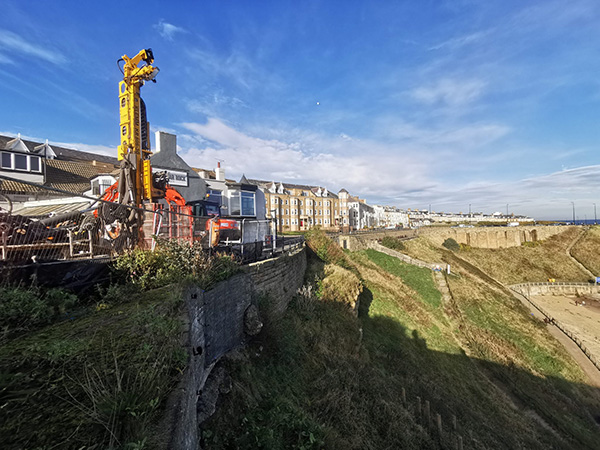
Slope stabilisation case studies from Aarsleff Ground Engineering show driven steel sheet piles, a 10 m-deep contiguous piled wall and soil nails being tailored to constrained brownfield and heritage sites in Alnwick, Tynemouth and Northampton. Solutions include 57.6 m and 20 m sheet-piled retaining walls installed with silent press and Movax to protect listed masonry, a 300 mm-diameter contiguous wall with 3 m rock bolts, gabions and 25 m² carved shotcrete for a 120-year cliff design life, and 8 m R32 hollow-bar soil nails designed via 3D clash modelling around buried services.
Technical Brief
- Global stability analysis of the Alnwick slope and existing wall informed an “adaptable yet optimised” retaining design.
- Sheet piling at Alnwick was sequenced in two stages to suit ongoing earthworks and building upgrade works.
- Silent press installation at the Alnwick car park was mandated to control vibration adjacent to an extant masonry wall ~1 m away.
- At Gibraltar Rock, a 2‑stage process began with trial pits to characterise the failure mechanism and refine a costed scheme.
- Demolition of ~3 m of failed cliff at Gibraltar Rock was carried out from a scaffold platform to reach competent sandstone before piling.
- The 10 m‑deep contiguous wall at Gibraltar Rock was tied back with 3 m rock bolts, gabions and carved, dyed shotcrete to match Victorian masonry.
- Emergency works at Gibraltar Rock required demolition sequencing and scaffold solutions specifically developed to protect pubs, restaurants and an English Heritage site below.
- In Northampton, three rows of 8 m R32 hollow‑bar nails were drilled in ≥100 mm bores through a reinforced soil block into Mudstone.
- A193 mesh with 150 mm sprayed concrete formed a hard structural facing in Northampton, providing a robust, inspectable surface.
Our Take
Aarsleff Ground Engineering’s work at Alnwick, Gibraltar Rock and Northampton aligns with its push in our database towards bundled ‘integrated ground solutions’, signalling that UK clients are increasingly comfortable procuring complex slope stabilisation and foundations from a single specialist contractor.
The 120‑year design life at Gibraltar Rock is at the upper end of what appears in recent UK geotechnical project coverage, suggesting that heritage stakeholders such as English Heritage and North Tyneside Council are now demanding asset lives comparable with major transport or flood-defence schemes rather than short- to medium-term fixes.
Prepared by collating external sources, AI-assisted tools, and Geomechanics.io’s proprietary mining database, then reviewed for technical accuracy & edited by our geotechnical team.
Related Articles

Related Industries & Products
Construction
Quality control software for construction companies with material testing, batch tracking, and compliance management.
Mining
Geotechnical software solutions for mining operations including CMRR analysis, hydrogeological testing, and data management.
CMRR-io
Streamline coal mine roof stability assessments with our cloud-based CMRR software featuring automated calculations, multi-scenario analysis, and collaborative workflows.
HYDROGEO-io
Comprehensive hydrogeological testing platform for managing, analysing, and reporting on packer tests, lugeon values, and hydraulic conductivity assessments.
GEODB-io
Centralised geotechnical data management solution for storing, accessing, and analysing all your site investigation and material testing data.