Geomechanics.io

  • Free Tools
Sign UpLog In

Geomechanics.io

Geomechanics, Streamlined.

© 2026 Geomechanics.io. All rights reserved.

Geomechanics.io

CMRR-ioGEODB-ioHYDROGEO-ioQCDB-ioFree Tools & CalculatorsBlogLatest Industry News

Industries

MiningConstructionTunnelling

Company

Terms of UsePrivacy PolicyLinkedIn
    AllGeotechnicalMiningInfrastructureMaterialsHazardsEnvironmentalSoftwarePolicy
    Projects
    Safety

    Network Rail £41M North West earthworks: design and risk notes for geotechnical teams

    September 22, 2026|

    Reviewed by Joe Ashwell

    Network Rail £41M North West earthworks: design and risk notes for geotechnical teams

    First reported on New Civil Engineer

    30 Second Briefing

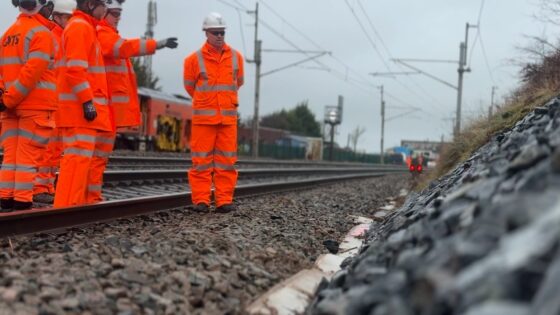
    Network Rail is delivering £41M of earthworks across key North West rail corridors to improve cuttings and embankments against winter rainfall, freeze–thaw and slope instability. Works are expected to include regrading and strengthening of existing earthwork assets, improved drainage systems and renewed trackside access to reduce washouts, slips and emergency speed restrictions. Geotechnical teams will need to manage construction around live traffic, legacy Victorian earth structures and variable ground conditions typical of the region’s glacial tills and weathered rock.

    Technical Brief

    • Investment scale signals a shift towards proactive slope risk reduction rather than reactive emergency stabilisation.

    Our Take

    The concentration of recent Network Rail items around short, intense possessions (for example, the Cardiff–Bridgend renewals and Chiltern Main Line works) suggests that North West earthworks contractors will likely be pressured to package geotechnical interventions into similarly tight blockade windows, favouring solutions with rapid curing and minimal follow-up maintenance.

    The Tottenham Hale ground improvement project using resin injection shows Network Rail’s willingness to adopt specialist ground engineering methods, which may open the door for non-traditional stabilisation techniques on North West earthworks where access constraints or live-rail interfaces make conventional regrade-and-rebuild options difficult.

    Geotechnical Software for Modern Teams

    Centralise site data, logs, and lab results with GEODB-io, CMRR-io, and HYDROGEO-io.

    No credit card required.

    • Save and export unlimited calculations
    • Advanced data visualisation
    • Generate professional PDF reports
    • Cloud storage for all your projects

    Prepared by collating external sources, AI-assisted tools, and Geomechanics.io’s proprietary mining database, then reviewed for technical accuracy & edited by our geotechnical team.

    Related Articles

    Fens Reservoir earthworks trials: settlement and seepage lessons for engineers
    Geotechnical
    5 days ago

    Fens Reservoir earthworks trials: settlement and seepage lessons for engineers

    Consultation has opened on temporary earthworks trials by Anglian Water and Cambridge Water to test construction methods for a proposed £2.2bn strategic reservoir in the Cambridgeshire Fens. The trials will focus on how to build and compact large embankments in low-lying, soft ground typical of fenland, de-risking long-term settlement and seepage behaviour before full design is finalised. Outcomes will influence material selection, ground improvement strategy and construction sequencing for the main reservoir earthworks.

    Geobear stabilises Hackbridge Station: geopolymer injection lessons for ground engineers
    Geotechnical
    7 days ago

    Geobear stabilises Hackbridge Station: geopolymer injection lessons for ground engineers

    Geobear has stabilised foundations at Hackbridge Station in South London by injecting expanding geopolymer beneath an 1868 station extension instead of using traditional underpinning. More than 30 injection points at 1 m centres were drilled through the existing floor, with steel tubes delivering material at three treatment depths to about 3 m, targeting clay weakened by historic drainage failures and waterlogged conditions at 1.3–3.3 m depth. The non-vibratory, internal-only works avoided major excavation near live Southern and Thameslink infrastructure and reduced risk of inducing further differential movement.

    Former Australian coal mine solar and battery: geotechnical lessons for engineers
    Geotechnical
    10 days ago

    Former Australian coal mine solar and battery: geotechnical lessons for engineers

    A 176MW solar farm with a 100MWh battery system is being built on a former coal mine site near Muswellbrook in New South Wales, repurposing disturbed land for large-scale renewable generation. Converting the pit and spoil areas to PV arrays and battery pads will require detailed geotechnical validation of backfilled ground, settlement behaviour and drainage, along with management of any residual mine subsidence. For civil contractors, the project offers brownfield grid connection advantages but demands careful earthworks, foundation design and contamination control.

    Related Industries & Products

    Construction

    Quality control software for construction companies with material testing, batch tracking, and compliance management.

    QCDB-io

    Comprehensive quality control database for manufacturing, tunnelling, and civil construction with UCS testing, PSD analysis, and grout mix design management.