Geomechanics.io

  • Free Tools
Sign UpLog In

Geomechanics.io

Geomechanics, Streamlined.

© 2026 Geomechanics.io. All rights reserved.

Geomechanics.io

CMRR-ioGEODB-ioHYDROGEO-ioQCDB-ioFree Tools & CalculatorsBlogLatest Industry News

Industries

MiningConstructionTunnelling

Company

Terms of UsePrivacy PolicyLinkedIn
    AllGeotechnicalMiningInfrastructureMaterialsHazardsEnvironmentalSoftwarePolicy
    Projects
    Failure
    Safety

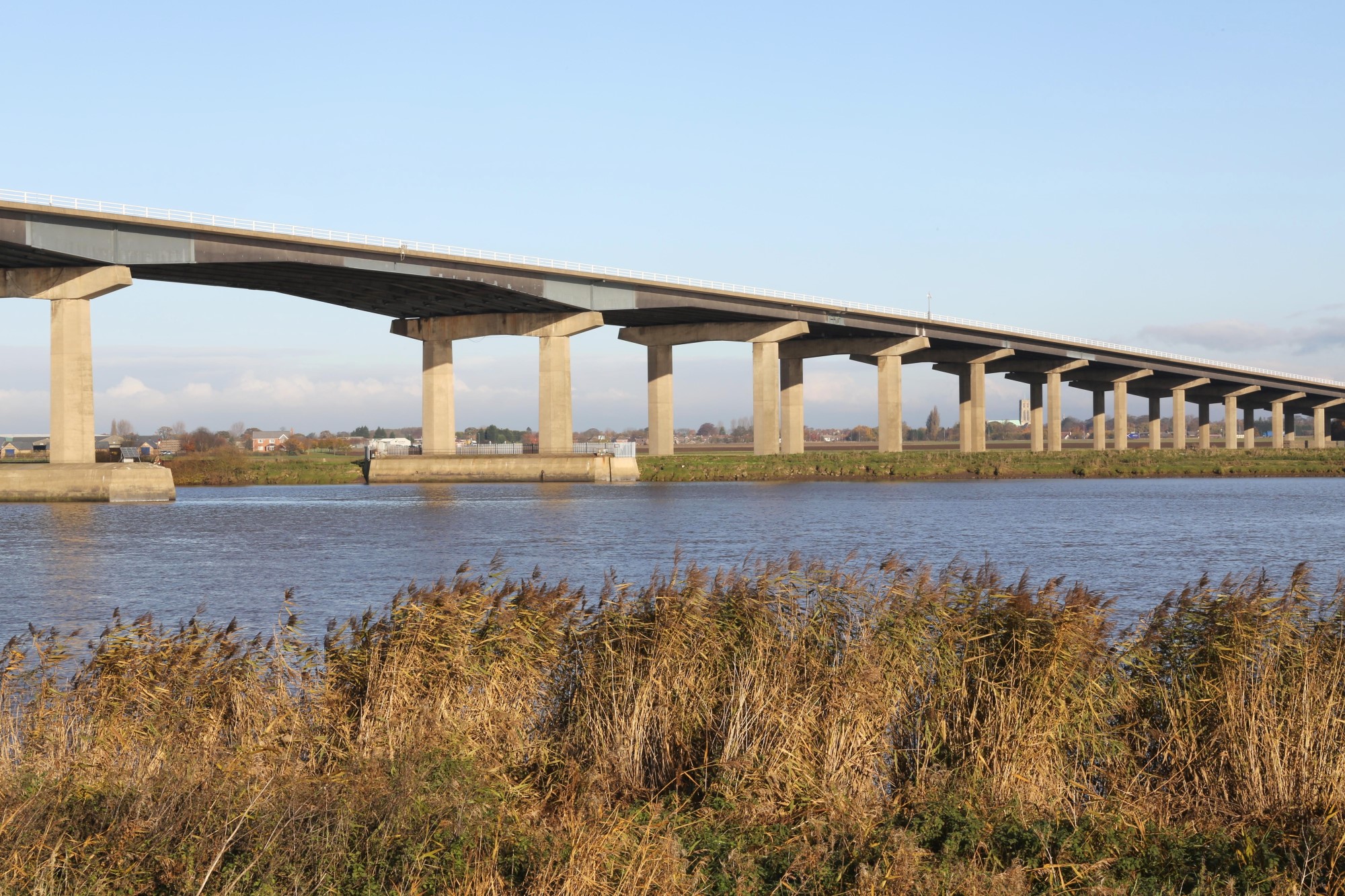
    M62 Ouse Bridge joint replacement: fatigue and detailing lessons for engineers

    December 12, 2025|

    Reviewed by Joe Ashwell

    M62 Ouse Bridge joint replacement: fatigue and detailing lessons for engineers

    First reported on New Civil Engineer

    30 Second Briefing

    Contractors will return to the M62 Ouse Bridge over the River Ouse this weekend (13–14 December) to replace a damaged expansion joint installed only a couple of years ago, following an unexpected bolt failure earlier this year. National Highways plans to complete the joint replacement under a short-duration closure to minimise disruption on this key trans-Pennine route between junctions 36 and 37. The repeat intervention on a relatively new joint raises questions over detailing, fatigue performance and inspection regimes for heavily trafficked motorway bridges.

    Technical Brief

    • Investigation likely involves detailed visual inspection, torque checks, non-destructive testing of remaining bolts and review of joint detailing drawings.
    • Temporary traffic management and lane closures are required to provide safe access to the joint zone above live carriageways and water.
    • Monitoring during and after works will focus on joint movement, bolt relaxation and early signs of fretting or slippage under traffic loading.
    • Replacement works provide an opportunity to reassess inspection intervals, bolt-retightening regimes and condition-based monitoring for heavily trafficked motorway bridge joints.
    • Similar UK motorway structures with recent joint renewals may face increased scrutiny of bolt detailing, installation records and fatigue design assumptions.

    Our Take

    Within the 240 Infrastructure stories in our database, only a small subset of UK pieces tagged with both ‘Failure’ and ‘Safety’ involve repeat interventions on the same asset, which suggests the M62 Ouse Bridge case may attract closer scrutiny of inspection and sign-off processes for major structures.

    A joint requiring replacement roughly two years after installation on the M62 Ouse Bridge will likely feed into National Highways’ lifecycle cost models, as early-life component failures on strategic routes tend to drive more conservative specifications and tighter contractor performance clauses on subsequent contracts.

    Among the 619 tag-matched pieces, bridge-related failures in the United Kingdom often trigger temporary capacity restrictions rather than full closures, so practitioners can expect traffic management and staged works on the M62 Ouse Bridge to be as much a political and public-acceptance issue as a technical repair exercise.

    Geotechnical Software for Modern Teams

    Centralise site data, logs, and lab results with GEODB-io, CMRR-io, and HYDROGEO-io.

    No credit card required.

    • Save and export unlimited calculations
    • Advanced data visualisation
    • Generate professional PDF reports
    • Cloud storage for all your projects

    Prepared by collating external sources, AI-assisted tools, and Geomechanics.io’s proprietary mining database, then reviewed for technical accuracy & edited by our geotechnical team.

    Related Articles

    Implenia/Marti JV MehrSpur Zurich–Winterthur: design and risk notes for engineers
    Infrastructure
    in 6 months

    Implenia/Marti JV MehrSpur Zurich–Winterthur: design and risk notes for engineers

    Swiss Federal Railways has awarded an Implenia/Marti 50:50 joint venture five of six MehrSpur Zurich–Winterthur lots worth just under CHF 1.7 billion, including the 8.3 km Brüttener tunnel (Lot 240) with twin 10 m diameter single-track tubes and a 1 km spur to Zurich Airport. TBM excavation will start in August 2029, with a roughly ten-year construction phase using BIM for planning and execution and extensive special foundations, earthworks and embankments. Additional works cover full redevelopment of Dietlikon station, about 6 km of new track across Dietlikon and Wallisellen sections, multiple underpasses, bridges and the Neumühle railway bridge and Storchen underpass near Winterthur.

    Xihe on Tung Chung Line down-track: TBM turnback method and risks for tunnel engineers
    Infrastructure
    in 4 months

    Xihe on Tung Chung Line down-track: TBM turnback method and risks for tunnel engineers

    TBM Xihe, a 7.3m-diameter, 100m-long, 1,000-tonne Herrenknecht slurry machine, has completed the up-track drive to the future Tung Chung West Station and has begun boring the down-track tunnel towards Tung Chung Station for MTR’s Tung Chung Line Extension in Hong Kong. The Bouygues Travaux Publics–Dragages Hong Kong JV turned the TBM underground within the launch shaft using a push-pull method and self-propelled modular transporter, avoiding full disassembly and surface transport. About 1.3km of new twin-bore tunnels are being driven close to existing rail and urban structures, with commissioning targeted for 2029.

    Sydney Metro Stations Package West: design and delivery notes for engineers
    Infrastructure
    in 3 months

    Sydney Metro Stations Package West: design and delivery notes for engineers

    Gamuda Engineering has secured the Sydney Metro Stations Package West as principal contractor, covering design and construction of five new underground stations at Westmead, North Strathfield, Burwood North, Five Dock and The Bays on the 24km Sydney Metro West line between Greater Parramatta and the CBD. The scope includes deep station boxes, entrances and access points, full station fit-out and integration with surrounding precincts, with Laing O’Rourke and DT Infrastructure joining as MetroVista delivery partners. Site works are scheduled to start on Monday, 5 January 2026.

    Related Industries & Products

    Mining

    Geotechnical software solutions for mining operations including CMRR analysis, hydrogeological testing, and data management.

    Construction

    Quality control software for construction companies with material testing, batch tracking, and compliance management.

    CMRR-io

    Streamline coal mine roof stability assessments with our cloud-based CMRR software featuring automated calculations, multi-scenario analysis, and collaborative workflows.

    HYDROGEO-io

    Comprehensive hydrogeological testing platform for managing, analysing, and reporting on packer tests, lugeon values, and hydraulic conductivity assessments.

    GEODB-io

    Centralised geotechnical data management solution for storing, accessing, and analysing all your site investigation and material testing data.