Geomechanics.io

  • Free Tools
Sign UpLog In

Geomechanics.io

Geomechanics, Streamlined.

© 2026 Geomechanics.io. All rights reserved.

Geomechanics.io

CMRR-ioGEODB-ioHYDROGEO-ioQCDB-ioFree Tools & CalculatorsBlogLatest Industry News

Industries

MiningConstructionTunnelling

Company

Terms of UsePrivacy PolicyLinkedIn
    AllGeotechnicalMiningInfrastructureMaterialsHazardsEnvironmentalSoftwarePolicy
    Projects
    Failure
    Safety

    Great Western Highway Mitchells Causeway: design and risk notes for engineers

    May 7, 2026|

    Reviewed by Tom Sullivan

    Great Western Highway Mitchells Causeway: design and risk notes for engineers

    First reported on Roads & Infrastructure (AU)

    30 Second Briefing

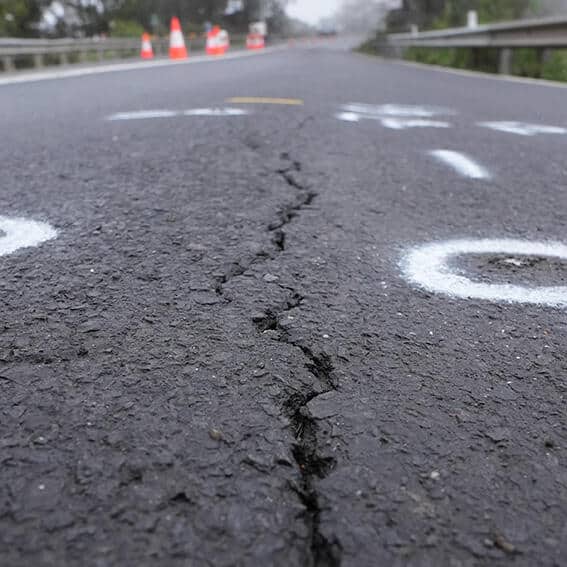
    Transport for NSW is shortlisting engineering solutions to reinstate Mitchells Causeway on the Great Western Highway after a defect in the pavement over the structure forced closure of Victoria Pass on 12 March. Subsequent investigations identified serious stress fractures forming in the westbound lanes, prompting a $50 million New South Wales Government package to upgrade key detour routes now carrying diverted traffic. Geotechnical and structural options for the causeway will need to address cracking behaviour under heavy freight loads and steep Blue Mountains topography while maintaining network resilience during works.

    Technical Brief

    • Failure investigation is focusing on interaction between pavement layers, waterproofing, and underlying structural elements under traffic.
    • Monitoring during interim operation would require frequent crack mapping, deflection surveys and possibly continuous strain or tilt sensors.
    • Remediation design will need staged construction and traffic management to maintain detour safety and emergency access.
    • Lessons on early crack detection and redundancy of mountain highway links are directly relevant to other steep-grade freight corridors.

    Our Take

    Transport for NSW’s $50 million spend on Great Western Highway detour routes sits alongside other slope- and structure‑risk works in New South Wales, such as the Bruxner Highway landslip repairs at Mallanganee, signalling a sustained program of geotechnical resilience upgrades rather than an isolated failure response.

    In our database of 821 Infrastructure stories, Transport for NSW appears frequently in safety‑ and failure‑tagged pieces, suggesting the agency is increasingly treating landslip, downslope and ageing‑asset risks as a statewide portfolio issue rather than project‑by‑project remediation.

    The focus on Victoria Pass and Mitchells Causeway aligns with other recent NSW Government investments in regional freight corridors for renewables logistics, meaning any long‑term solution here will likely need to accommodate heavier and more specialised freight loads than the original highway design anticipated.

    Geotechnical Software for Modern Teams

    Centralise site data, logs, and lab results with GEODB-io, CMRR-io, and HYDROGEO-io.

    No credit card required.

    • Save and export unlimited calculations
    • Advanced data visualisation
    • Generate professional PDF reports
    • Cloud storage for all your projects

    Prepared by collating external sources, AI-assisted tools, and Geomechanics.io’s proprietary mining database, then reviewed for technical accuracy & edited by our geotechnical team.

    Related Articles

    Strabag’s Pfaffensteig Tunnel contract: design and delivery notes for rail engineers
    Infrastructure
    in 6 months

    Strabag’s Pfaffensteig Tunnel contract: design and delivery notes for rail engineers

    Strabag and Group company Züblin have secured the design-and-build structural works for the ABS Gäubahn Nord/Pfaffensteig Tunnel in south-west Germany, centred on an 11km twin-bore rail tunnel linking Stuttgart Airport station directly to the Gäubahn line towards Switzerland. About 9.8km will be driven by two TBMs, with conventional tunnelling for the A8 motorway undercrossing and airport connection, plus a 240m cut-and-cover section, retaining structures, railway underpasses and a grade-separated crossing. A 3km surface section will be upgraded and partially realigned for 200km/h operation, delivered under an integrated project delivery model with Ed. Züblin, Wayss & Freytag and Strabag AG sharing tunnelling, structural and earthworks packages.

    National Grid TBM under the Thames: tunnelling design and risk notes for engineers
    Infrastructure
    in 6 months

    National Grid TBM under the Thames: tunnelling design and risk notes for engineers

    A 271.5‑tonne Herrenknecht Mixshield TBM, Caroline, has started driving a 2.2km electricity cable tunnel with a 4m internal diameter beneath the River Thames in Essex for National Grid’s Grain to Tilbury project, delivered by the Ferrovial BEMO joint venture. The drive will pass through variable Thames estuary ground conditions between 35m‑deep launch and reception shafts of 15m and 12m diameter, with tunnelling continuing into 2026 and overall scheme completion targeted for 2029. The new tunnel will replace the 1969 Thames Cable Tunnel and carry new high‑voltage circuits between Grain and Tilbury substations.

    Panama Canal Mixshield undercrossing: design and tunnelling lessons for engineers
    Infrastructure
    in 6 months

    Panama Canal Mixshield undercrossing: design and tunnelling lessons for engineers

    A 13.46m diameter Herrenknecht Mixshield TBM has broken through into the future Balboa station on Panama Metro Line 3 after completing the first-ever TBM undercrossing of the Panama Canal at depths exceeding 60m below sea level. The 5,600kW, 26,616kNm machine, fitted with an accessible cutterhead and more than 4,500 sensors linked via the Herrenknecht.Connected platform, has achieved peak advance of 150 segment rings (about 300m) per month through mixed sandstone, tuff, breccias and basalt. Around 1.5km of the 4.5km twin-track tunnel remains to final breakthrough.

    Related Industries & Products

    Construction

    Quality control software for construction companies with material testing, batch tracking, and compliance management.

    Mining

    Geotechnical software solutions for mining operations including CMRR analysis, hydrogeological testing, and data management.

    QCDB-io

    Comprehensive quality control database for manufacturing, tunnelling, and civil construction with UCS testing, PSD analysis, and grout mix design management.