Geomechanics.io

  • Free Tools
Sign UpLog In

Geomechanics.io

Geomechanics, Streamlined.

© 2026 Geomechanics.io. All rights reserved.

Geomechanics.io

CMRR-ioGEODB-ioHYDROGEO-ioQCDB-ioFree Tools & CalculatorsBlogLatest Industry News

Industries

MiningConstructionTunnelling

Company

Terms of UsePrivacy PolicyLinkedIn
    AllGeotechnicalMiningInfrastructureMaterialsHazardsEnvironmentalSoftwarePolicy
    Failure
    Safety
    Projects

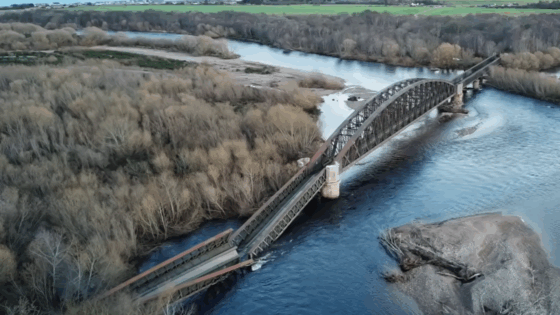
    Garmouth Spey viaduct collapse: inspection and survey lessons for engineers

    December 15, 2025|

    Reviewed by Joe Ashwell

    Garmouth Spey viaduct collapse: inspection and survey lessons for engineers

    First reported on New Civil Engineer

    30 Second Briefing

    The 19th-century Garmouth Viaduct over the River Spey in Moray, Scotland has collapsed, exposing a decade-long failure to act on a 2014 recommendation for a full structural survey. The former rail viaduct, now used as a pedestrian and cycle crossing, had already been subject to partial closures after previous flood damage and scour concerns. The incident raises immediate questions over inspection regimes, asset management of legacy wrought-iron and masonry structures, and how local authorities prioritise intrusive surveys for ageing river crossings.

    Technical Brief

    • Typical investigation now would combine dive inspections, bathymetric survey, pier core sampling and metallurgical assessment of ironwork.
    • Ongoing monitoring, if reinstatement is considered, would need real-time water level, scour and displacement instrumentation on piers.
    • Incident exposes a gap between routine visual inspections and more intrusive surveys for non-standard, heritage river crossings.
    • Safety management of legacy pedestrian structures may need reclassification to bridge-type inspection regimes with stricter intervals.

    Our Take

    Among the 253 Infrastructure stories in our coverage, only a small subset of the 654 safety- and failure-tagged pieces involve 19th-century assets in the United Kingdom, suggesting ageing structures like the Garmouth Viaduct in Moray are now standing out as higher-risk legacy elements in local networks.

    A recommendation for a full structural survey going unfulfilled since 2014 signals a governance gap that asset owners of similar historic bridges in Scotland will likely be pressed to address through more formalised inspection regimes and clearer accountability chains.

    For practitioners, the Spey viaduct case underlines that once a detailed survey is formally recommended on an older structure, deferring it effectively shifts the risk profile from technical uncertainty to management liability, which can influence insurers’ and regulators’ stance on comparable projects.

    Geotechnical Software for Modern Teams

    Centralise site data, logs, and lab results with GEODB-io, CMRR-io, and HYDROGEO-io.

    No credit card required.

    • Save and export unlimited calculations
    • Advanced data visualisation
    • Generate professional PDF reports
    • Cloud storage for all your projects

    Prepared by collating external sources, AI-assisted tools, and Geomechanics.io’s proprietary mining database, then reviewed for technical accuracy & edited by our geotechnical team.

    Related Articles

    Implenia/Marti JV MehrSpur Zurich–Winterthur: design and risk notes for engineers
    Infrastructure
    in 6 months

    Implenia/Marti JV MehrSpur Zurich–Winterthur: design and risk notes for engineers

    Swiss Federal Railways has awarded an Implenia/Marti 50:50 joint venture five of six MehrSpur Zurich–Winterthur lots worth just under CHF 1.7 billion, including the 8.3 km Brüttener tunnel (Lot 240) with twin 10 m diameter single-track tubes and a 1 km spur to Zurich Airport. TBM excavation will start in August 2029, with a roughly ten-year construction phase using BIM for planning and execution and extensive special foundations, earthworks and embankments. Additional works cover full redevelopment of Dietlikon station, about 6 km of new track across Dietlikon and Wallisellen sections, multiple underpasses, bridges and the Neumühle railway bridge and Storchen underpass near Winterthur.

    Xihe on Tung Chung Line down-track: TBM turnback method and risks for tunnel engineers
    Infrastructure
    in 4 months

    Xihe on Tung Chung Line down-track: TBM turnback method and risks for tunnel engineers

    TBM Xihe, a 7.3m-diameter, 100m-long, 1,000-tonne Herrenknecht slurry machine, has completed the up-track drive to the future Tung Chung West Station and has begun boring the down-track tunnel towards Tung Chung Station for MTR’s Tung Chung Line Extension in Hong Kong. The Bouygues Travaux Publics–Dragages Hong Kong JV turned the TBM underground within the launch shaft using a push-pull method and self-propelled modular transporter, avoiding full disassembly and surface transport. About 1.3km of new twin-bore tunnels are being driven close to existing rail and urban structures, with commissioning targeted for 2029.

    Sydney Metro Stations Package West: design and delivery notes for engineers
    Infrastructure
    in 3 months

    Sydney Metro Stations Package West: design and delivery notes for engineers

    Gamuda Engineering has secured the Sydney Metro Stations Package West as principal contractor, covering design and construction of five new underground stations at Westmead, North Strathfield, Burwood North, Five Dock and The Bays on the 24km Sydney Metro West line between Greater Parramatta and the CBD. The scope includes deep station boxes, entrances and access points, full station fit-out and integration with surrounding precincts, with Laing O’Rourke and DT Infrastructure joining as MetroVista delivery partners. Site works are scheduled to start on Monday, 5 January 2026.

    Related Industries & Products

    Mining

    Geotechnical software solutions for mining operations including CMRR analysis, hydrogeological testing, and data management.

    Construction

    Quality control software for construction companies with material testing, batch tracking, and compliance management.

    CMRR-io

    Streamline coal mine roof stability assessments with our cloud-based CMRR software featuring automated calculations, multi-scenario analysis, and collaborative workflows.

    HYDROGEO-io

    Comprehensive hydrogeological testing platform for managing, analysing, and reporting on packer tests, lugeon values, and hydraulic conductivity assessments.

    GEODB-io

    Centralised geotechnical data management solution for storing, accessing, and analysing all your site investigation and material testing data.