Geomechanics.io

  • Free Tools
Sign UpLog In
AllGeotechnicalMiningInfrastructureMaterialsHazardsEnvironmentalSoftwarePolicy

Geomechanics.io

Geomechanics, Streamlined.

© 2026 Geomechanics.io. All rights reserved.

Geomechanics.io

CMRR-ioGEODB-ioHYDROGEO-ioQCDB-ioFree Tools & CalculatorsBlogLatest Industry News

Industries

MiningConstructionTunnelling

Company

Terms of UsePrivacy PolicyLinkedIn
    Standard/Guideline
    Safety
    Sustainability

    DfT climate adaptation strategy: design and risk takeaways for UK transport engineers

    January 7, 2026|

    Reviewed by Joe Ashwell

    DfT climate adaptation strategy: design and risk takeaways for UK transport engineers

    First reported on New Civil Engineer

    30 Second Briefing

    The Department for Transport has released a national climate adaptation strategy for Britain’s transport system, setting out how rail, road, ports and aviation infrastructure should cope with more frequent flooding, heatwaves and coastal erosion. Measures include requiring asset owners to embed climate risk into design standards and renewals, prioritising resilience upgrades on critical corridors and interchanges, and improving data on weather-related failures. For geotechnical and civil engineers, this signals tighter expectations on drainage capacity, slope stability, track and pavement performance under extreme temperatures, and long-term asset monitoring.

    Technical Brief

    • For similar national networks, the document provides a template for aligning climate adaptation with formal safety regulation.

    Our Take

    The Department for Transport appears frequently in our Policy coverage, and pairing this climate adaptation strategy with its stance on the Ely Area Capacity Enhancement scheme suggests future rail capacity upgrades in the UK may be increasingly judged against resilience and climate-risk criteria as well as traditional cost–benefit tests.

    Among the 383 tag-matched pieces on Safety and Sustainability, relatively few are central-government-led frameworks, so this DfT strategy is likely to become a reference point for how local authorities and infrastructure owners in Britain justify design standards and maintenance regimes under changing climate baselines.

    For UK transport operators, a formal DfT adaptation strategy typically signals that forthcoming standards and guidance will harden from ‘good practice’ into de facto requirements, affecting long-term asset management plans and procurement for everything from drainage and earthworks to signalling and control systems.

    Geotechnical Software for Modern Teams

    Centralise site data, logs, and lab results with GEODB-io, CMRR-io, and HYDROGEO-io.

    No credit card required.

    • Save and export unlimited calculations
    • Advanced data visualisation
    • Generate professional PDF reports
    • Cloud storage for all your projects

    Prepared by collating external sources, AI-assisted tools, and Geomechanics.io’s proprietary mining database, then reviewed for technical accuracy & edited by our geotechnical team.

    Related Articles
    Government policies to drive mining investment in 2026: key takeaways for project teams
    Policy
    about 19 hours ago

    Government policies to drive mining investment in 2026: key takeaways for project teams

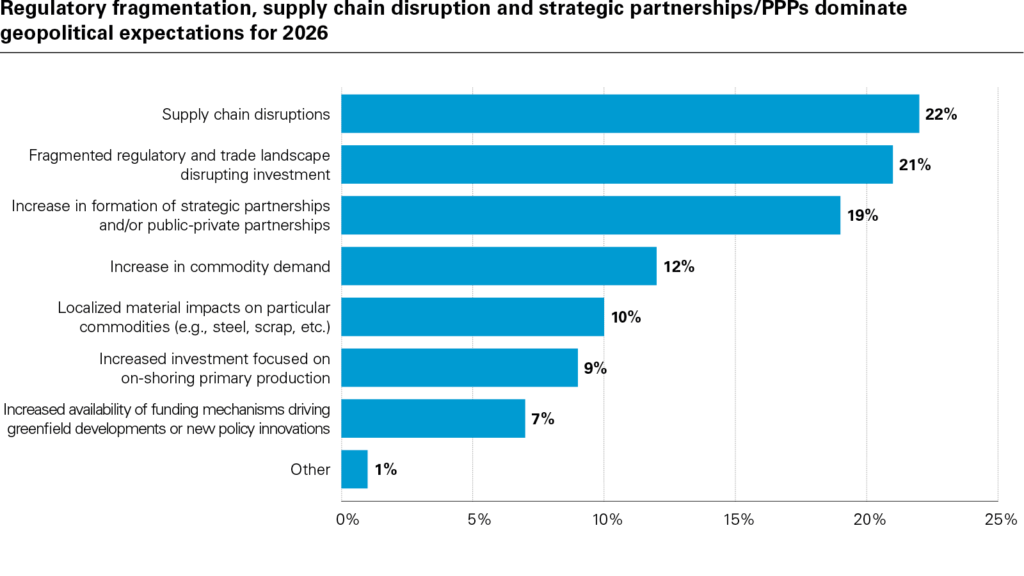
    Government policy is set to dominate mining investment in 2026, with 47% of respondents to White & Case’s Mining & Metals 2026 survey citing political variables and nearly 40% expecting state‑backed financing to be the main tool in developed markets. Some 73% foresee widening divergence between US and Chinese critical minerals policy, while a funding gap between the US and Europe is seen as a key opportunity, alongside risks of over‑expansion and a two‑to‑three‑year “gold rush” bubble. Copper and gold are viewed as the “sure bet” price risers, with gold miners seen as prime consolidation targets and strategic partnerships favoured over traditional M&A.

    Sustainability and transparent reporting in construction: key shifts for engineers
    Policy
    1 day ago

    Sustainability and transparent reporting in construction: key shifts for engineers

    Sustainability reporting in construction is described as fragmented and inconsistent, with project disclosures difficult to compare and data quality varying widely across contractors and asset owners. This patchwork approach is exposing schemes to reputational, regulatory and operational risk, particularly as clients demand verifiable carbon footprints, lifecycle assessments and supply chain traceability aligned with frameworks such as the GHG Protocol and EU taxonomy. For geotechnical and civil engineers, the direction of travel points to standardised metrics on embodied carbon in concrete and steel, site energy use and materials sourcing becoming routine contract requirements.

    Phil Layton as CECE president: decarbonisation and EU machinery rules for engineers
    Policy
    1 day ago

    Phil Layton as CECE president: decarbonisation and EU machinery rules for engineers

    JCB technical service director Phil Layton has begun a two-year term as president of the Committee for European Construction Equipment (CECE), representing the UK’s Construction Equipment Association. Layton plans to prioritise decarbonisation of construction machinery fleets, support for open global markets and a more competitive regulatory framework for European OEMs. CECE’s immediate policy push targets EU secondary legislation on road circulation of construction machinery and a guidance document for implementing the new Machinery Regulation, ahead of the CECE congress in London on 27–29 October.

    Related Industries & Products

    Construction

    Quality control software for construction companies with material testing, batch tracking, and compliance management.

    Mining

    Geotechnical software solutions for mining operations including CMRR analysis, hydrogeological testing, and data management.

    CMRR-io

    Streamline coal mine roof stability assessments with our cloud-based CMRR software featuring automated calculations, multi-scenario analysis, and collaborative workflows.

    HYDROGEO-io

    Comprehensive hydrogeological testing platform for managing, analysing, and reporting on packer tests, lugeon values, and hydraulic conductivity assessments.

    GEODB-io

    Centralised geotechnical data management solution for storing, accessing, and analysing all your site investigation and material testing data.