Geomechanics.io

  • Free Tools
Sign UpLog In
AllGeotechnicalMiningInfrastructureMaterialsHazardsEnvironmentalSoftwarePolicy

Geomechanics.io

Geomechanics, Streamlined.

© 2026 Geomechanics.io. All rights reserved.

Geomechanics.io

CMRR-ioGEODB-ioHYDROGEO-ioQCDB-ioFree Tools & CalculatorsBlogLatest Industry News

Industries

MiningConstructionTunnelling

Company

Terms of UsePrivacy PolicyLinkedIn
    Projects
    Sustainability

    Belfast Harbour D3 deep-water berth: geotechnical design notes for engineers

    September 18, 2026|

    Reviewed by Joe Ashwell

    Belfast Harbour D3 deep-water berth: geotechnical design notes for engineers

    First reported on New Civil Engineer

    30 Second Briefing

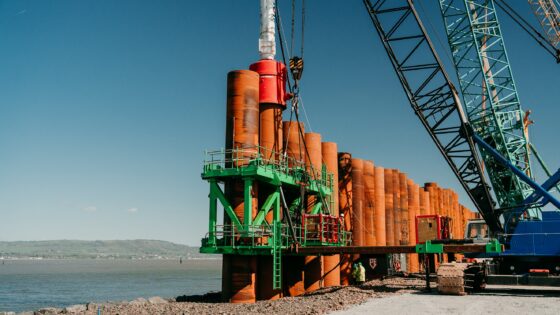
    Belfast Harbour’s £90M D3 project is converting reclaimed land into a deep-water quay designed to berth large cruise vessels and support offshore wind installation vessels, within tight tidal windows in a heavily trafficked channel. Engineers are contending with variable fill and soft alluvial deposits, requiring ground improvement and careful quay wall design to control settlement and lateral movement under high berthing and crane loads. Construction methods are being adapted to strict environmental constraints in Belfast Lough, including turbidity limits and noise controls for marine habitats.

    Technical Brief

    • Quay wall adopts a combi-wall system with large diameter tubular piles and infill sheet piles.
    • Designers have allowed for high vertical crane loads from offshore wind jack-up vessels on the deck slab.
    • Ground model differentiates historic dock infill from underlying estuarine clays to target localised improvement zones.
    • Instrumentation includes settlement plates and inclinometers to track post-construction movements against tight serviceability criteria.
    • Construction sequencing keeps surcharge and heavy plant away from quay edge until wall performance is verified.
    • Tidal working windows drive use of pre-assembled reinforcement cages and large prefabricated concrete units.
    • Turbidity is controlled using silt curtains and real-time monitoring buoys linked to automatic work stoppage thresholds.
    • Noise mitigation combines bubble curtains around piling works with restricted hammer energy and time-of-day limits.

    Our Take

    The £90M D3 development sits within Belfast Harbour’s previously announced £1.3bn long-term capital programme, signalling that this berth is one of several staged upgrades rather than a one-off intervention.

    Within our 25 Geotechnical stories, relatively few focus on port land reclamation, so the D3 project positions Belfast Harbour as an early reference case for combining deep-water capacity with sustainability-led ground engineering.

    For practitioners, the scale of D3 relative to the wider £1.3bn programme suggests ground improvement and reclamation methods proven here are likely to be standardised and rolled out across subsequent Belfast Harbour works.

    Geotechnical Software for Modern Teams

    Centralise site data, logs, and lab results with GEODB-io, CMRR-io, and HYDROGEO-io.

    No credit card required.

    • Save and export unlimited calculations
    • Advanced data visualisation
    • Generate professional PDF reports
    • Cloud storage for all your projects

    Prepared by collating external sources, AI-assisted tools, and Geomechanics.io’s proprietary mining database, then reviewed for technical accuracy & edited by our geotechnical team.

    Related Articles
    Growing foundations reuse: investigation, reliability and carbon lessons for engineers
    Geotechnical
    2 days ago

    Growing foundations reuse: investigation, reliability and carbon lessons for engineers

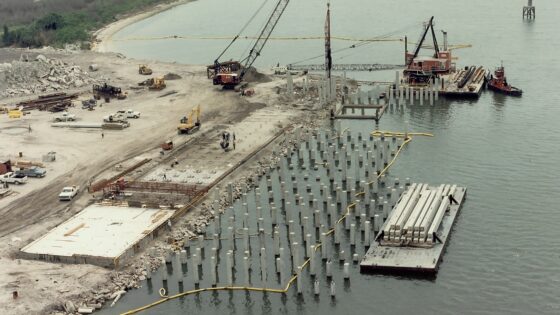
    Reuse of existing piled and raft foundations is accelerating on commercial property schemes as clients accept higher investigation spend in exchange for major embodied carbon and programme savings. Engineers are combining detailed pile integrity testing, targeted coring and advanced geotechnical back‑analysis with updated Eurocode‑based reliability methods to justify reusing legacy foundations originally designed for very different load cases. Planning and funding bodies are now more willing to accept partial reuse strategies, shifting project briefs away from default demolition and full replacement towards selective strengthening, load‑sharing and local pile augmentation.

    Chalk foundations in the UK: investigation and design lessons for engineers
    Geotechnical
    3 days ago

    Chalk foundations in the UK: investigation and design lessons for engineers

    Industry geotechnical specialists at the John Mitchell lecture warned that UK foundation design on chalk is still misjudging key behaviours such as solution features, variable weathering profiles and the risk of brittle collapse under cyclic loading. Speakers pointed to recent pile and shallow foundation projects where inadequate chalk characterisation, limited core recovery and over-reliance on generic SPT correlations led to unexpected settlements and construction delays. Attendees were urged to adopt more rigorous chalk-specific investigation, including targeted boreholes, high-quality sampling and site-specific load testing, before finalising foundation schemes.

    Network Rail £41M North West earthworks: design and risk notes for geotechnical teams
    Geotechnical
    3 days ago

    Network Rail £41M North West earthworks: design and risk notes for geotechnical teams

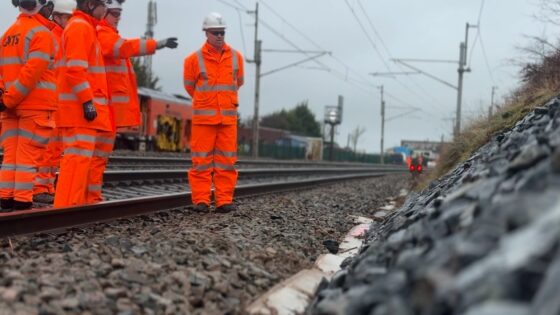
    Network Rail is delivering £41M of earthworks across key North West rail corridors to improve cuttings and embankments against winter rainfall, freeze–thaw and slope instability. Works are expected to include regrading and strengthening of existing earthwork assets, improved drainage systems and renewed trackside access to reduce washouts, slips and emergency speed restrictions. Geotechnical teams will need to manage construction around live traffic, legacy Victorian earth structures and variable ground conditions typical of the region’s glacial tills and weathered rock.

    Related Industries & Products

    Construction

    Quality control software for construction companies with material testing, batch tracking, and compliance management.

    Mining

    Geotechnical software solutions for mining operations including CMRR analysis, hydrogeological testing, and data management.

    QCDB-io

    Comprehensive quality control database for manufacturing, tunnelling, and civil construction with UCS testing, PSD analysis, and grout mix design management.