Teenager’s fatal fall case: HSE lessons on work-at-height and asbestos control
Reviewed by Tom Sullivan
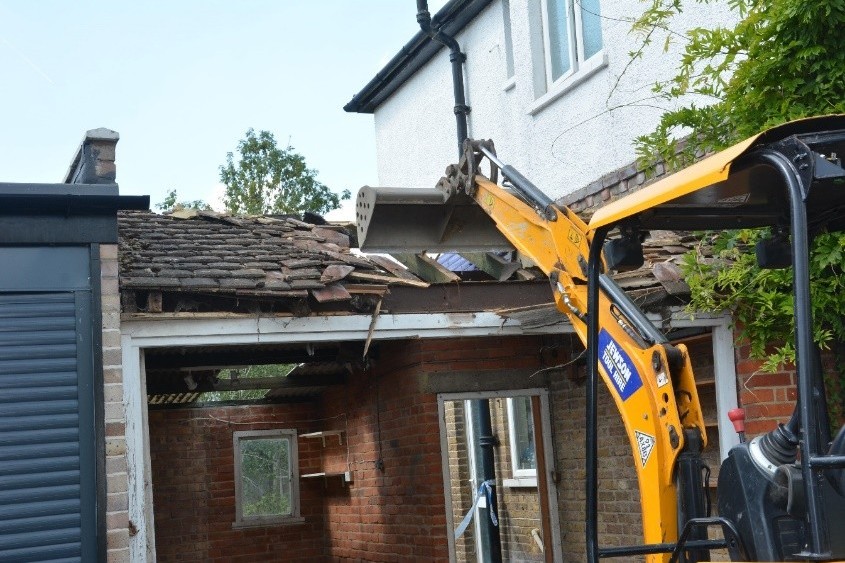
First reported on The Construction Index
30 Second Briefing
A self-employed contractor has been jailed for 12 months after 19-year-old labourer Thomas Neate died from head injuries sustained when he fell through an opening while stripping tiles from a domestic garage roof in Staines-upon-Thames on 16 August 2023. HSE investigators found the demolition was carried out directly from the roof with no scaffolding, decking or fall-prevention system, alongside unsafe mini-digger use and unrestricted public access to the site. Asbestos cement sheets were also broken up and removed by hand with no prior survey, exposing three other workers and the household to fibre risk.
Technical Brief
- Failure mechanism centred on an unprotected roof opening during manual tile stripping, with no load-bearing covers.
- HSE investigation focused on work-at-height planning, access arrangements, plant operation and asbestos management on the domestic site.
- Unsafe mini-digger use was identified, indicating inadequate plant competence checks and poor segregation from pedestrian work areas.
- Site perimeter control was absent, allowing unrestricted public access and breaching basic temporary works and CDM-style site security expectations.
- No pre-demolition asbestos survey was undertaken, despite corrugated sheets later being confirmed as asbestos cement products.
- Asbestos cement sheets were snapped and hand-carried, creating uncontrolled fibre release to workers and the resident family.
- Prosecution was under Section 3(2) of the Health and Safety at Work etc. Act 1974, emphasising duties to non-employees.
- For similar small domestic demolitions, structured work-at-height plans, asbestos surveys and exclusion zones are critical monitoring controls.
Our Take
The Health & Safety Executive features across multiple recent UK Hazards cases in our database, including roof‑work incidents brought before High Wycombe and Birmingham magistrates’ courts, signalling that work at height remains a consistent enforcement focus rather than an isolated lapse in Surrey.
Asbestos appears only rarely in the 38 Hazards stories but is prominent in this Staines‑upon‑Thames case, underlining that small domestic-scale jobs can still trigger complex dual‑risk scenarios (fall from height plus legacy asbestos exposure) that many sole traders are poorly set up to manage.
Compared with other recent HSE prosecutions that resulted in suspended sentences or fines for non‑fatal falls, the 12‑month custodial term here suggests courts are prepared to treat failures on small residential projects as seriously as larger commercial sites when a young worker is killed.
Prepared by collating external sources, AI-assisted tools, and Geomechanics.io’s proprietary mining database, then reviewed for technical accuracy & edited by our geotechnical team.
Related Articles


Related Industries & Products
Mining
Geotechnical software solutions for mining operations including CMRR analysis, hydrogeological testing, and data management.
CMRR-io
Streamline coal mine roof stability assessments with our cloud-based CMRR software featuring automated calculations, multi-scenario analysis, and collaborative workflows.
HYDROGEO-io
Comprehensive hydrogeological testing platform for managing, analysing, and reporting on packer tests, lugeon values, and hydraulic conductivity assessments.
GEODB-io
Centralised geotechnical data management solution for storing, accessing, and analysing all your site investigation and material testing data.