Mainmark Godstone sinkhole repairs: resin injection lessons for ground engineers
Reviewed by Joe Ashwell
First reported on The Construction Index
30 Second Briefing
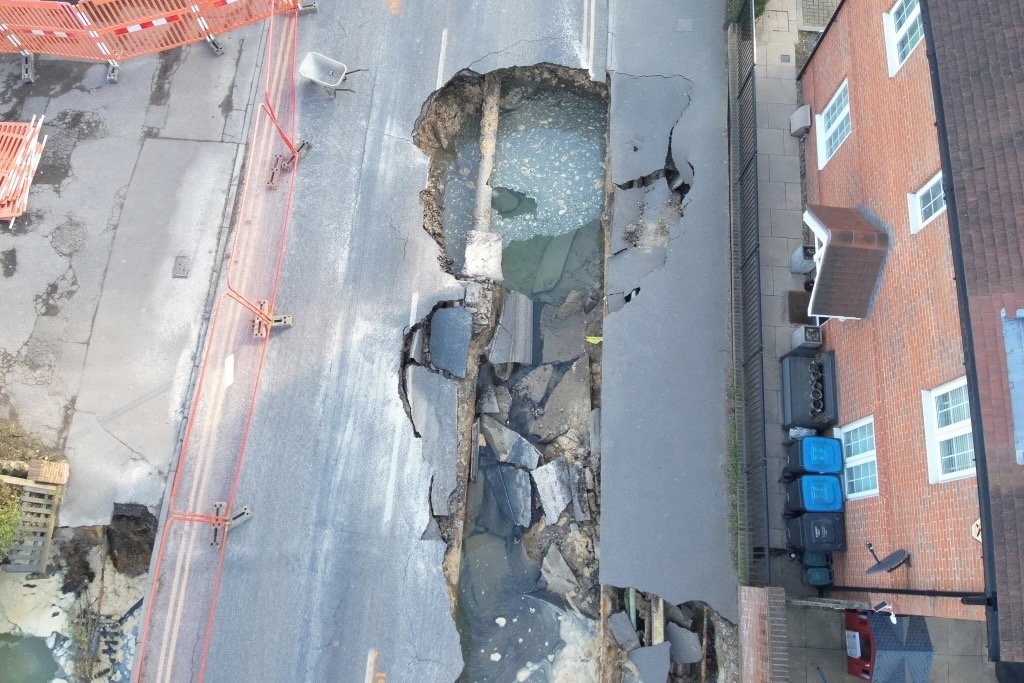
Mainmark has completed a three‑week ground improvement programme in Godstone, Surrey, following an 18‑month repair effort after a 20m long, 5m wide, 5m deep sinkhole on the High Street exposed historic sand mine workings about 8m below ground. Working within a multidisciplinary team for Surrey County Council, Mainmark installed roughly 600 resin injection points across High Street and Salisbury Road, targeting depths of 1–4m to strengthen weak and disturbed ground. The works aimed to cut off potential void migration pathways above the remediated mine network before full road reconstruction.
Technical Brief
- Ground collapse in February 2025 created a 20m × 5m × 5m void in Godstone High Street.
- Subsequent investigation identified historic sand mine workings approximately 8m below the village footprint.
- Initial failure mechanism was linked to sandstone erosion from a burst water main, then reclassified as multi‑cause.
- Deeper mine workings were first remediated by the wider project team before near‑surface treatment commenced.
- Mainmark’s resin injection was explicitly used as a secondary barrier to block future void migration pathways.
- Mainmark emphasised that damaged utilities alone rarely explain collapses, reinforcing the need for full subsurface forensics.
- Case underlines that legacy shallow mining beneath highways demands layered remediation strategies, not single‑technique fixes.
Our Take
Mainmark UK’s use of resin injection at the Godstone sand voids echoes its Tottenham Hale station work for Network Rail, signalling that rail and local authorities in the UK are increasingly comfortable with resin-based stabilisation for critical transport assets rather than full reconstruction.
An 18‑month repair programme with around 600 injection points over shallow depths suggests that for legacy shallow mine workings like those beneath Godstone in Surrey, staged, targeted treatment is becoming a preferred risk‑management approach over large‑scale excavation, especially where high streets must remain partially operational.
Within our 26 Geotechnical stories, Mainmark appears repeatedly in pavement and rail rehabilitation pieces, indicating that its Teretek-style resin systems are moving from niche remediation into a standard option for managing subsidence and voiding in sand‑dominated ground conditions in the UK and Australia.
Prepared by collating external sources, AI-assisted tools, and Geomechanics.io’s proprietary mining database, then reviewed for technical accuracy & edited by our geotechnical team.
Related Articles



Related Industries & Products
Mining
Geotechnical software solutions for mining operations including CMRR analysis, hydrogeological testing, and data management.
Construction
Quality control software for construction companies with material testing, batch tracking, and compliance management.
CMRR-io
Streamline coal mine roof stability assessments with our cloud-based CMRR software featuring automated calculations, multi-scenario analysis, and collaborative workflows.
HYDROGEO-io
Comprehensive hydrogeological testing platform for managing, analysing, and reporting on packer tests, lugeon values, and hydraulic conductivity assessments.
GEODB-io
Centralised geotechnical data management solution for storing, accessing, and analysing all your site investigation and material testing data.