Geomechanics.io

  • Free Tools
Sign UpLog In
AllGeotechnicalMiningInfrastructureMaterialsHazardsEnvironmentalSoftwarePolicy

Geomechanics.io

Geomechanics, Streamlined.

© 2026 Geomechanics.io. All rights reserved.

Geomechanics.io

CMRR-ioGEODB-ioHYDROGEO-ioQCDB-ioFree Tools & CalculatorsBlogLatest Industry News

Industries

MiningConstructionTunnelling

Company

Terms of UsePrivacy PolicyLinkedIn
    Projects
    Sustainability

    Low water storage levels: on-farm reservoirs and design notes for engineers

    November 11, 2026|

    Reviewed by Tom Sullivan

    Low water storage levels: on-farm reservoirs and design notes for engineers

    First reported on New Civil Engineer

    30 Second Briefing

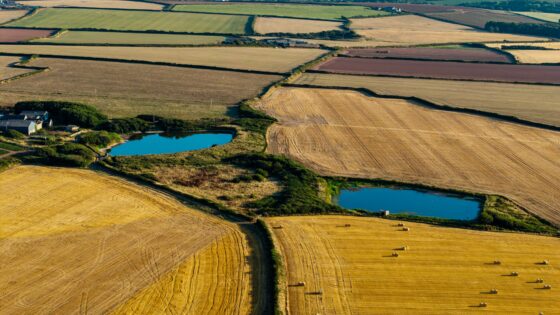
    Below-average water levels in England’s strategic reservoirs are prompting industry bodies to push for easier planning and permitting of on-farm reservoirs to secure irrigation supplies. Proposals focus on small to medium earth-bunded storage ponds drawing winter high flows from local rivers or boreholes, with lined embankments and controlled abstraction to protect low summer flows. For civil and geotechnical engineers, this signals rising demand for costed designs, slope stability assessments and leakage control for numerous dispersed reservoirs on agricultural land.

    Technical Brief

    • Below-average levels are reported across England’s strategic reservoirs, reducing headroom for public water supply security.
    • Calls target relaxation of planning and abstraction licensing specifically for agricultural on-farm storage schemes.
    • Policy discussion centres on shifting part of irrigation supply risk from regional reservoirs to dispersed farm assets.
    • Water companies’ current storage deficits are being used as justification for accelerating private reservoir approvals.
    • Regulatory bodies are being pressed to streamline environmental assessment steps for small earthwork impoundments.
    • Engineering consultancies are likely to see more small, fast-turnaround reservoir commissions rather than a few large schemes.
    • For civil contractors, the pipeline implies more minor earthworks packages distributed across rural sites with variable access.

    Our Take

    Because New Civil Engineer’s recent coverage and events (such as the BIM/data handover webinar) emphasise asset management, on‑farm reservoirs in the United Kingdom are likely to be scrutinised not just for embankment stability but for long-term monitoring, data capture and integration with catchment-scale water planning.

    For England, where many sustainability‑tagged pieces in our database revolve around urban infrastructure, shifting attention to dispersed, privately owned reservoirs implies more fragmented consenting and design standards, which could drive demand for simple, repeatable geotechnical design templates that farmers and local consultants can implement at scale.

    Geotechnical Software for Modern Teams

    Centralise site data, logs, and lab results with GEODB-io, CMRR-io, and HYDROGEO-io.

    No credit card required.

    • Save and export unlimited calculations
    • Advanced data visualisation
    • Generate professional PDF reports
    • Cloud storage for all your projects

    Prepared by collating external sources, AI-assisted tools, and Geomechanics.io’s proprietary mining database, then reviewed for technical accuracy & edited by our geotechnical team.

    Related Articles

    Fens Reservoir earthworks trials: settlement and seepage lessons for engineers
    Geotechnical
    5 days ago

    Fens Reservoir earthworks trials: settlement and seepage lessons for engineers

    Consultation has opened on temporary earthworks trials by Anglian Water and Cambridge Water to test construction methods for a proposed £2.2bn strategic reservoir in the Cambridgeshire Fens. The trials will focus on how to build and compact large embankments in low-lying, soft ground typical of fenland, de-risking long-term settlement and seepage behaviour before full design is finalised. Outcomes will influence material selection, ground improvement strategy and construction sequencing for the main reservoir earthworks.

    Geobear stabilises Hackbridge Station: geopolymer injection lessons for ground engineers
    Geotechnical
    7 days ago

    Geobear stabilises Hackbridge Station: geopolymer injection lessons for ground engineers

    Geobear has stabilised foundations at Hackbridge Station in South London by injecting expanding geopolymer beneath an 1868 station extension instead of using traditional underpinning. More than 30 injection points at 1 m centres were drilled through the existing floor, with steel tubes delivering material at three treatment depths to about 3 m, targeting clay weakened by historic drainage failures and waterlogged conditions at 1.3–3.3 m depth. The non-vibratory, internal-only works avoided major excavation near live Southern and Thameslink infrastructure and reduced risk of inducing further differential movement.

    Former Australian coal mine solar and battery: geotechnical lessons for engineers
    Geotechnical
    10 days ago

    Former Australian coal mine solar and battery: geotechnical lessons for engineers

    A 176MW solar farm with a 100MWh battery system is being built on a former coal mine site near Muswellbrook in New South Wales, repurposing disturbed land for large-scale renewable generation. Converting the pit and spoil areas to PV arrays and battery pads will require detailed geotechnical validation of backfilled ground, settlement behaviour and drainage, along with management of any residual mine subsidence. For civil contractors, the project offers brownfield grid connection advantages but demands careful earthworks, foundation design and contamination control.

    Related Industries & Products

    Construction

    Quality control software for construction companies with material testing, batch tracking, and compliance management.

    Mining

    Geotechnical software solutions for mining operations including CMRR analysis, hydrogeological testing, and data management.

    CMRR-io

    Streamline coal mine roof stability assessments with our cloud-based CMRR software featuring automated calculations, multi-scenario analysis, and collaborative workflows.

    HYDROGEO-io

    Comprehensive hydrogeological testing platform for managing, analysing, and reporting on packer tests, lugeon values, and hydraulic conductivity assessments.

    GEODB-io

    Centralised geotechnical data management solution for storing, accessing, and analysing all your site investigation and material testing data.