Chimney Hollow ACRD dam delivery: design and construction lessons for engineers
Reviewed by Joe Ashwell
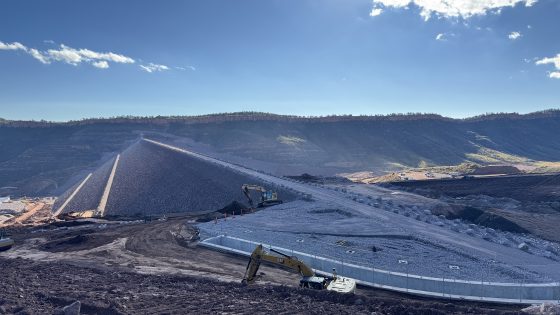
First reported on New Civil Engineer
30 Second Briefing
Construction of the Chimney Hollow Reservoir in Colorado has delivered the US’s largest asphalt-core rockfill dam (ACRD), with main works now complete and the structure built to full height on schedule. Engineers had to manage complex rockfill placement around a central asphalt core, stringent seepage control, and tight temperature and compaction windows for the asphaltic concrete in a high-altitude environment. The project’s performance will be closely watched by dam designers considering ACRD solutions for sites with challenging foundations and seismic demands.
Technical Brief
- Asphalt core constructed in narrow central slot, requiring millimetre-level alignment with adjacent rockfill zones.
- Construction sequencing maintained continuous upstream and downstream rockfill support to limit differential deformation against the asphalt core.
- Temperature-controlled asphalt batching and insulated transport trucks were used to keep mix within tight placement limits.
- On-core compaction plant operated on a restricted-width platform, demanding strict traffic management and edge stability control.
- Instrumentation embedded in the core and shoulders provides continuous monitoring of temperature, deformation and seepage during first filling.
- Emergency action planning and downstream public-safety coordination were integrated with commissioning to address first-impoundment risk scenarios.
- Experience at Chimney Hollow is expected to inform US dam-safety regulators’ guidance on future ACRD approvals.
Our Take
Within the 517 Infrastructure stories in our database, very few cover advanced concrete-faced or asphalt-core rockfill dams in the United States, so Chimney Hollow reservoir effectively becomes a reference case for large embankment dam delivery under current US regulatory and environmental constraints.
Safety-tagged project pieces in the US often centre on ageing dam rehabilitation rather than new-build assets, which suggests lessons from Chimney Hollow’s construction sequencing, monitoring and risk management will likely be watched by operators planning upgrades to existing structures in similar seismic and hydrological settings.
Because New Civil Engineer’s coverage of US projects tends to focus on transport and urban works, a large water-storage asset like Chimney Hollow stands out as an indicator that long-lead water infrastructure is moving back up the priority list for US authorities facing drought resilience and peak-demand concerns.
Prepared by collating external sources, AI-assisted tools, and Geomechanics.io’s proprietary mining database, then reviewed for technical accuracy & edited by our geotechnical team.
Related Articles


Related Industries & Products
Construction
Quality control software for construction companies with material testing, batch tracking, and compliance management.
Mining
Geotechnical software solutions for mining operations including CMRR analysis, hydrogeological testing, and data management.
QCDB-io
Comprehensive quality control database for manufacturing, tunnelling, and civil construction with UCS testing, PSD analysis, and grout mix design management.