Geomechanics.io

  • Free Tools
Sign UpLog In

Geomechanics.io

Geomechanics, Streamlined.

© 2026 Geomechanics.io. All rights reserved.

Geomechanics.io

CMRR-ioGEODB-ioHYDROGEO-ioQCDB-ioFree Tools & CalculatorsBlogLatest Industry News

Industries

MiningConstructionTunnelling

Company

Terms of UsePrivacy PolicyLinkedIn
    AllGeotechnicalMiningInfrastructureMaterialsHazardsEnvironmentalSoftwarePolicy
    Safety
    Failure

    Bow Tie Construction ladder fall: HSE findings and lessons for site engineers

    February 17, 2026|

    Reviewed by Tom Sullivan

    Bow Tie Construction ladder fall: HSE findings and lessons for site engineers

    First reported on The Construction Index

    30 Second Briefing

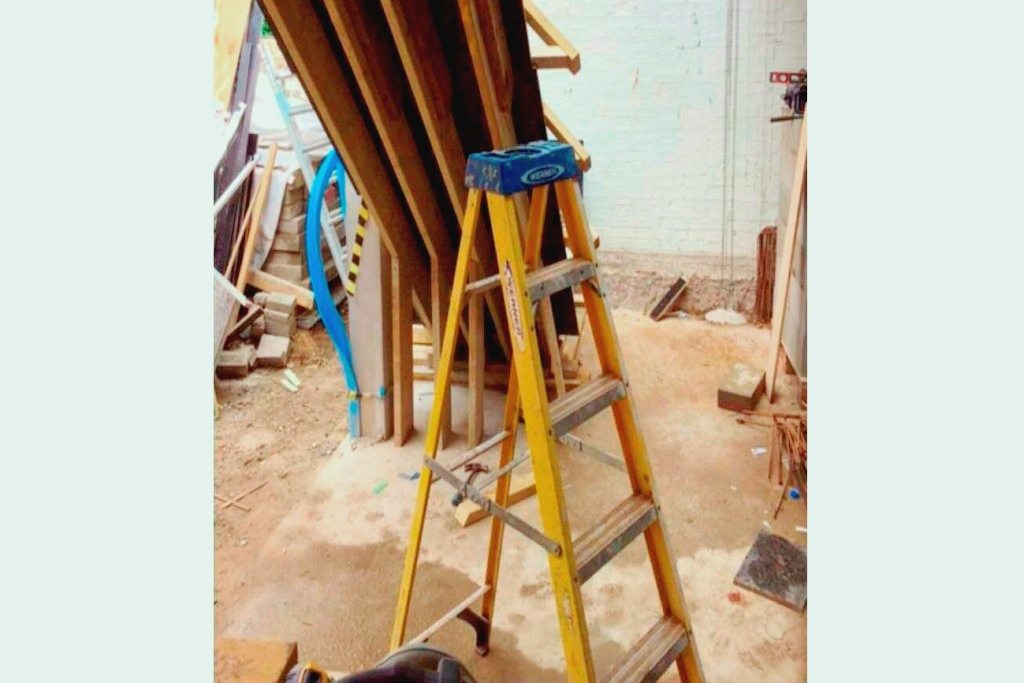
    A High Wycombe contractor, Bow Tie Construction Limited, has been fined £24,000 plus £4,101 costs at Southwark Crown Court after a worker fell 1.65 metres from the top of a five‑foot stepladder while using a gas‑powered nail gun on temporary timber formwork for a new concrete staircase in an Islington refurbishment. The fall caused crush injuries to both elbows requiring multiple surgeries, a fractured forearm, dislocated wrists and leg and knee damage. HSE found no safe system of work for height, inadequate edge protection, incorrectly assembled tower scaffolds and uncontrolled ladder use, despite a prior prohibition notice one month earlier.

    Technical Brief

    • Temporary timber formwork was being installed for a new in‑situ concrete staircase between ground and first floors.
    • Work was part of converting a domestic property and former handbag factory into a single dwelling, implying complex existing geometry and constrained access.
    • Company director Rafael Delimata was acting site manager and personally instructed the three‑person team to build the formwork.
    • HSE investigation identified systemic work‑at‑height failures: inadequate edge protection, mis‑assembled tower scaffolds and unprotected stair voids.
    • A prohibition notice for height‑safety failings had been served on Bow Tie Construction only one month earlier, indicating prior regulatory intervention.
    • Monitoring and remediation should include formal work‑at‑height risk assessments, scaffold inspection records and ladder‑use permits, with periodic HSE compliance audits.
    • Breach was prosecuted under Section 2(1) of the Health and Safety at Work etc. Act 1974, reinforcing statutory duties for safe systems of work at height on refurbishment sites.

    Our Take

    Within the 420 safety- and failure-tagged pieces in our database, UK Health & Safety Executive (HSE) prosecutions like this one involving Bow Tie Construction Limited are a recurring theme, signalling that enforcement risk for even relatively low-height work-at-height incidents remains high.

    The 1.65 m fall height sits in the range where many infrastructure cases in our coverage involve step ladders or short access equipment, underscoring that contractors in places like High Wycombe and Islington cannot treat ‘low’ work-at-height as routine or exempt from formal controls.

    The long interval between the August 2021 incident and the February 2026 Southwark Crown Court hearing is consistent with other UK infrastructure safety cases in our database, meaning duty holders should factor multi‑year legal and reputational exposure into their risk and insurance planning when HSE becomes involved.

    Geotechnical Software for Modern Teams

    Centralise site data, logs, and lab results with GEODB-io, CMRR-io, and HYDROGEO-io.

    No credit card required.

    • Save and export unlimited calculations
    • Advanced data visualisation
    • Generate professional PDF reports
    • Cloud storage for all your projects

    Prepared by collating external sources, AI-assisted tools, and Geomechanics.io’s proprietary mining database, then reviewed for technical accuracy & edited by our geotechnical team.

    Related Articles

    Strabag’s Pfaffensteig Tunnel contract: design and delivery notes for rail engineers
    Infrastructure
    in 6 months

    Strabag’s Pfaffensteig Tunnel contract: design and delivery notes for rail engineers

    Strabag and Group company Züblin have secured the design-and-build structural works for the ABS Gäubahn Nord/Pfaffensteig Tunnel in south-west Germany, centred on an 11km twin-bore rail tunnel linking Stuttgart Airport station directly to the Gäubahn line towards Switzerland. About 9.8km will be driven by two TBMs, with conventional tunnelling for the A8 motorway undercrossing and airport connection, plus a 240m cut-and-cover section, retaining structures, railway underpasses and a grade-separated crossing. A 3km surface section will be upgraded and partially realigned for 200km/h operation, delivered under an integrated project delivery model with Ed. Züblin, Wayss & Freytag and Strabag AG sharing tunnelling, structural and earthworks packages.

    National Grid TBM under the Thames: tunnelling design and risk notes for engineers
    Infrastructure
    in 6 months

    National Grid TBM under the Thames: tunnelling design and risk notes for engineers

    A 271.5‑tonne Herrenknecht Mixshield TBM, Caroline, has started driving a 2.2km electricity cable tunnel with a 4m internal diameter beneath the River Thames in Essex for National Grid’s Grain to Tilbury project, delivered by the Ferrovial BEMO joint venture. The drive will pass through variable Thames estuary ground conditions between 35m‑deep launch and reception shafts of 15m and 12m diameter, with tunnelling continuing into 2026 and overall scheme completion targeted for 2029. The new tunnel will replace the 1969 Thames Cable Tunnel and carry new high‑voltage circuits between Grain and Tilbury substations.

    Panama Canal Mixshield undercrossing: design and tunnelling lessons for engineers
    Infrastructure
    in 6 months

    Panama Canal Mixshield undercrossing: design and tunnelling lessons for engineers

    A 13.46m diameter Herrenknecht Mixshield TBM has broken through into the future Balboa station on Panama Metro Line 3 after completing the first-ever TBM undercrossing of the Panama Canal at depths exceeding 60m below sea level. The 5,600kW, 26,616kNm machine, fitted with an accessible cutterhead and more than 4,500 sensors linked via the Herrenknecht.Connected platform, has achieved peak advance of 150 segment rings (about 300m) per month through mixed sandstone, tuff, breccias and basalt. Around 1.5km of the 4.5km twin-track tunnel remains to final breakthrough.

    Related Industries & Products

    Construction

    Quality control software for construction companies with material testing, batch tracking, and compliance management.

    Mining

    Geotechnical software solutions for mining operations including CMRR analysis, hydrogeological testing, and data management.

    QCDB-io

    Comprehensive quality control database for manufacturing, tunnelling, and civil construction with UCS testing, PSD analysis, and grout mix design management.