Geomechanics.io

  • Free Tools
Sign UpLog In

Geomechanics.io

Geomechanics, Streamlined.

© 2026 Geomechanics.io. All rights reserved.

Geomechanics.io

CMRR-ioGEODB-ioHYDROGEO-ioQCDB-ioFree Tools & CalculatorsBlogLatest Industry News

Industries

MiningConstructionTunnelling

Company

Terms of UsePrivacy PolicyLinkedIn
    Projects
    Safety

    Attacks on mining operations in Pakistan: haul road risk lessons for project teams

    September 20, 2026|

    Reviewed by Tom Sullivan

    Attacks on mining operations in Pakistan: haul road risk lessons for project teams

    First reported on MINING.com

    30 Second Briefing

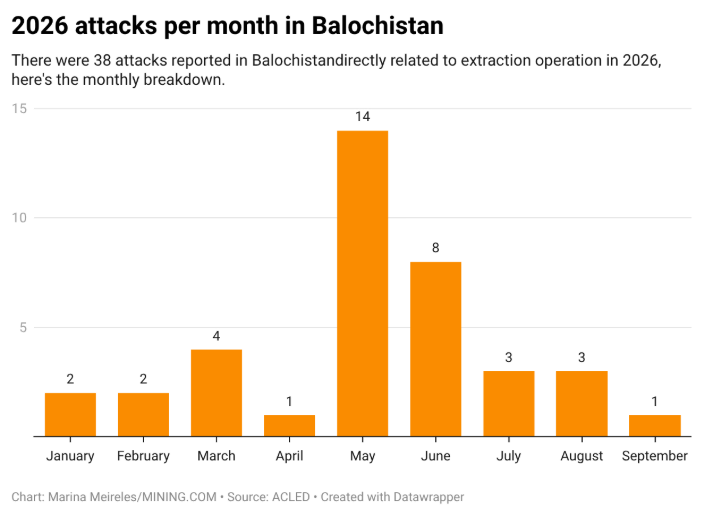
    More than 30 mining operations in Pakistan’s Balochistan province have been attacked in 2026, with ACLED recording 38 incidents linked to extractive activity between January and September and over 130 in the past three years. Nearly 90% of separatist attacks on mineral projects occur on haul and access roads, typically disabling coal and copper-gold trucks by shooting tyres and burning vehicles, while heavily guarded sites such as Reko Diq and Saindak see fewer direct assaults. The pattern exposes critical vulnerabilities in transport corridors and raises security, reputational and community‑relations risks for foreign-backed projects.

    Technical Brief

    • Less than 17% of recorded attacks use roadside bombs or landmines, limiting blast-type risks.
    • Over half of attacks on public oil and gas assets occur directly at extraction sites with lighter guarding.
    • Coal operations see roughly one‑third of incidents on mine sites, the balance occurring off‑site.
    • Militants frequently allow drivers to exit before torching trucks, shifting harm from personnel to assets.
    • Gunmen typically disable haulage by firing at tyres, immobilising vehicles without breaching armoured cabs.
    • Roadblocks and improvised checkpoints are increasingly used to channel traffic into ambush points on remote routes.
    • Flagship Reko Diq and Saindak copper‑gold mines rely on combined private and state security forces for perimeter defence.
    • Pakistan has deployed additional security forces in Balochistan, but ACLED stresses non‑security political and benefit‑sharing measures are also required.

    Our Take

    Within our 1273 Mining stories, Pakistan rarely appears in safety-tagged pieces compared with other Asian producers, so the concentration of over 130 extractive‑linked attacks in Balochistan marks it as an outlier risk environment for copper, gold and coal projects.

    The fact that nearly 90% of separatist attacks against mineral projects in Balochistan occur on roads has direct design implications for operators at assets like Reko Diq and Saindak, pushing more emphasis onto escorted convoys, hardened transport corridors, and possibly greater use of on‑site accommodation to reduce travel exposure.

    Because Balochistan hosts both bulk commodities such as coal and higher‑value critical minerals including copper and chromite, sustained attack levels of the sort ACLED records are likely to feed into higher security premia and discount rates in project economics compared with other South Asian jurisdictions in our database.

    Geotechnical Software for Modern Teams

    Centralise site data, logs, and lab results with GEODB-io, CMRR-io, and HYDROGEO-io.

    No credit card required.

    • Save and export unlimited calculations
    • Advanced data visualisation
    • Generate professional PDF reports
    • Cloud storage for all your projects

    Prepared by collating external sources, AI-assisted tools, and Geomechanics.io’s proprietary mining database, then reviewed for technical accuracy & edited by our geotechnical team.

    Related Articles

    Gold price slides on strong dollar: planning implications for mine projects
    Mining
    about 16 hours ago

    Gold price slides on strong dollar: planning implications for mine projects

    Gold prices slipped to a one-week low as spot gold fell 0.4% to $4,271.16/oz in New York and December futures eased 0.3% to $4,306 amid a stronger US dollar and expectations of more hawkish US Federal Reserve rate moves. The dollar hit a two-month high and US 10-year Treasury yields hovered near a 20-year peak, sharply raising the opportunity cost of holding non-yielding bullion. Oil gained about 1% on stalled US–Iran talks over the war, while spot silver dropped 1.8% to $63.29/oz, platinum 0.2% to $1,746.44, and palladium rose 0.5% to $1,266.40.

    OceanaGold Waihi expansion: design, throughput and tailings notes for engineers
    Mining
    about 16 hours ago

    OceanaGold Waihi expansion: design, throughput and tailings notes for engineers

    OceanaGold is weighing a 50% expansion of its Waihi plant to 1.2 Mt/y after Wharekirauponga drilling returned standout intercepts including 6.3 m at 97.2 g/t Au from 481.5 m in the East Graben vein and 8.5 m at 41.5 g/t from 399 m. The move would enable concurrent feed from Martha Underground and Wharekirauponga post‑2032, building on a 2024 plan outlining 1.6 Moz over 15 years and an initial 4.1 Mt reserve at 9.2 g/t. Underground development is advancing, with the Waihi North decline now 350 m, first vent shaft under construction, staged commissioning of a new water treatment plant, and early works on a new tailings storage facility due in Q4.

    Kinross Gold output cut and higher AISC: operational drivers and FCF lens for mine teams
    Mining
    about 17 hours ago

    Kinross Gold output cut and higher AISC: operational drivers and FCF lens for mine teams

    Kinross Gold has cut its 2026–27 production outlook by about 8% to 1.84–1.86 million attributable gold-equivalent oz. a year and raised 2024 AISC guidance to $1,850–$1,900/oz after winter storms, copper-rich sulphide ore and poor recoveries at La Coipa in Chile, plus weaker mining rates, grades and recoveries at Round Mountain Phase S in Nevada. The company is stockpiling high-copper material, studying a new flotation circuit for deeper sulphide mineralisation that may overlie a copper porphyry system, and using a smaller shovel at Round Mountain to cut dilution. Despite the operational hit and a Q3 output cut to about 425,000 oz., Kinross has lifted its 2026 shareholder return target to 50% of free cash flow and has already returned about $800 million this year, mainly via $655 million in buybacks.

    Related Industries & Products

    Mining

    Geotechnical software solutions for mining operations including CMRR analysis, hydrogeological testing, and data management.

    CMRR-io

    Streamline coal mine roof stability assessments with our cloud-based CMRR software featuring automated calculations, multi-scenario analysis, and collaborative workflows.

    HYDROGEO-io

    Comprehensive hydrogeological testing platform for managing, analysing, and reporting on packer tests, lugeon values, and hydraulic conductivity assessments.

    GEODB-io

    Centralised geotechnical data management solution for storing, accessing, and analysing all your site investigation and material testing data.

    AllGeotechnicalMiningInfrastructureMaterialsHazardsEnvironmentalSoftwarePolicy