Geomechanics.io

  • Free Tools
Sign UpLog In

Geomechanics.io

Geomechanics, Streamlined.

© 2026 Geomechanics.io. All rights reserved.

Geomechanics.io

CMRR-ioGEODB-ioHYDROGEO-ioQCDB-ioFree Tools & CalculatorsBlogLatest Industry News

Industries

MiningConstructionTunnelling

Company

Terms of UsePrivacy PolicyLinkedIn
    AllGeotechnicalMiningInfrastructureMaterialsHazardsEnvironmentalSoftwarePolicy
    Standard/Guideline
    Projects

    AMEC rare earths strategic reserve: project pipeline implications for engineers

    January 7, 2026|

    Reviewed by Tom Sullivan

    AMEC rare earths strategic reserve: project pipeline implications for engineers

    First reported on Australian Mining

    30 Second Briefing

    A proposed framework from the Association of Mining and Exploration Companies (AMEC) urges the Federal Government to establish a national strategic reserve for critical minerals, with rare earths as the initial focus. The plan centres on stockpiling processed products such as NdPr oxide and separated heavy rare earths, rather than unprocessed ore, to buffer supply shocks in defence, EV and grid-scale magnet supply chains. AMEC also calls for long-term offtake contracts and storage facilities co-located with existing processing hubs to anchor new Australian rare earth projects.

    Technical Brief

    • AMEC proposes government-funded storage hubs integrated with existing rare earth separation and refining plants.
    • Framework targets defence, EV and grid magnet supply chains explicitly as priority end-users.
    • Proposal emphasises processed intermediate products (oxides, separated elements) to avoid double-handling and reprocessing inefficiencies.
    • AMEC argues stockpile commitments would underpin project financing for new Australian rare earth mines and refineries.
    • Policy concept is modelled partly on petroleum strategic reserves but adapted to multi-product critical minerals.
    • Governance suggestions include transparent eligibility criteria for projects supplying the reserve and periodic review of target volumes.
    • AMEC notes current market volatility and price collapses have stalled several advanced rare earth project investment decisions.
    • Similar strategic reserve structures could later extend to battery metals once processing capacity is locally established.

    Our Take

    Rare earths and broader critical minerals appear in over 50 keyword-matched pieces in our database, signalling that AMEC’s reserve concept would land in a policy space already crowded with debates on supply security, export controls and downstream processing in Australia.

    Among Policy stories, Australia-focused critical minerals coverage often highlights tension between industrial users and upstream miners; the BlueScope Steel takeover piece from 5 January 2026 shows how strategic metals (including rare earth exposure) are now a factor in corporate control battles as well as government stockpile discussions.

    For Australian projects, a government-backed strategic reserve for rare earths and other critical minerals would likely change financing dynamics at feasibility stage, as offtake and price-risk assumptions could incorporate a domestic buyer of last resort rather than relying solely on export markets.

    Geotechnical Software for Modern Teams

    Centralise site data, logs, and lab results with GEODB-io, CMRR-io, and HYDROGEO-io.

    No credit card required.

    • Save and export unlimited calculations
    • Advanced data visualisation
    • Generate professional PDF reports
    • Cloud storage for all your projects

    Prepared by collating external sources, AI-assisted tools, and Geomechanics.io’s proprietary mining database, then reviewed for technical accuracy & edited by our geotechnical team.

    Related Articles
    Government policies to drive mining investment in 2026: key takeaways for project teams
    Policy
    about 19 hours ago

    Government policies to drive mining investment in 2026: key takeaways for project teams

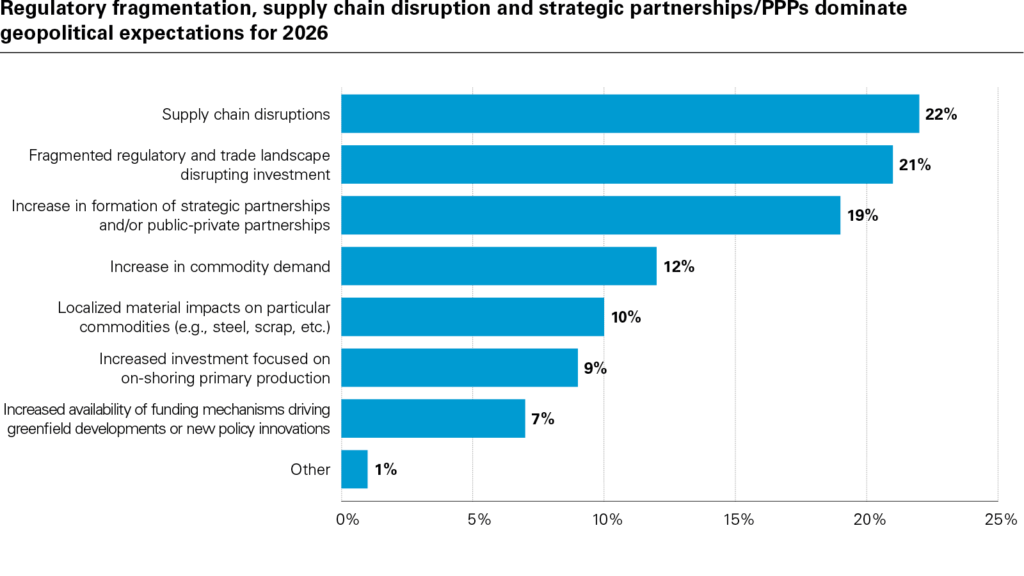
    Government policy is set to dominate mining investment in 2026, with 47% of respondents to White & Case’s Mining & Metals 2026 survey citing political variables and nearly 40% expecting state‑backed financing to be the main tool in developed markets. Some 73% foresee widening divergence between US and Chinese critical minerals policy, while a funding gap between the US and Europe is seen as a key opportunity, alongside risks of over‑expansion and a two‑to‑three‑year “gold rush” bubble. Copper and gold are viewed as the “sure bet” price risers, with gold miners seen as prime consolidation targets and strategic partnerships favoured over traditional M&A.

    Sustainability and transparent reporting in construction: key shifts for engineers
    Policy
    1 day ago

    Sustainability and transparent reporting in construction: key shifts for engineers

    Sustainability reporting in construction is described as fragmented and inconsistent, with project disclosures difficult to compare and data quality varying widely across contractors and asset owners. This patchwork approach is exposing schemes to reputational, regulatory and operational risk, particularly as clients demand verifiable carbon footprints, lifecycle assessments and supply chain traceability aligned with frameworks such as the GHG Protocol and EU taxonomy. For geotechnical and civil engineers, the direction of travel points to standardised metrics on embodied carbon in concrete and steel, site energy use and materials sourcing becoming routine contract requirements.

    Phil Layton as CECE president: decarbonisation and EU machinery rules for engineers
    Policy
    1 day ago

    Phil Layton as CECE president: decarbonisation and EU machinery rules for engineers

    JCB technical service director Phil Layton has begun a two-year term as president of the Committee for European Construction Equipment (CECE), representing the UK’s Construction Equipment Association. Layton plans to prioritise decarbonisation of construction machinery fleets, support for open global markets and a more competitive regulatory framework for European OEMs. CECE’s immediate policy push targets EU secondary legislation on road circulation of construction machinery and a guidance document for implementing the new Machinery Regulation, ahead of the CECE congress in London on 27–29 October.

    Related Industries & Products

    Mining

    Geotechnical software solutions for mining operations including CMRR analysis, hydrogeological testing, and data management.

    CMRR-io

    Streamline coal mine roof stability assessments with our cloud-based CMRR software featuring automated calculations, multi-scenario analysis, and collaborative workflows.

    HYDROGEO-io

    Comprehensive hydrogeological testing platform for managing, analysing, and reporting on packer tests, lugeon values, and hydraulic conductivity assessments.

    GEODB-io

    Centralised geotechnical data management solution for storing, accessing, and analysing all your site investigation and material testing data.