Geomechanics.io

  • Free Tools
Sign UpLog In

Geomechanics.io

Geomechanics, Streamlined.

© 2026 Geomechanics.io. All rights reserved.

Geomechanics.io

CMRR-ioGEODB-ioHYDROGEO-ioQCDB-ioFree Tools & CalculatorsBlogLatest Industry News

Industries

MiningConstructionTunnelling

Company

Terms of UsePrivacy PolicyLinkedIn
    AllGeotechnicalMiningInfrastructureMaterialsHazardsEnvironmentalSoftwarePolicy
    Standard/Guideline
    Sustainability

    AGS Chair’s blog September 2024: key geotechnical and sustainability takeaways

    November 21, 2025|

    Reviewed by Tom Sullivan

    AGS Chair’s blog September 2024: key geotechnical and sustainability takeaways

    First reported on AGS (UK) – Blog/Magazine

    30 Second Briefing

    AGS’s September issue centres on Fugro’s move to cut single‑use plastic in site investigation by recycling core liners, alongside guidance on structuring Employee Networks to support both staff and business performance. A new EC7 Next Gen bitesize guide stresses that BS EN 1991:2023 must be used to correctly apply FprEN 1997:2024 when assigning geotechnical risk categories to structures. Practitioners are also alerted to potential environmental law changes under the Retained EU Law Act 2023 and to upcoming AGS events on EDI, groundwater in design and construction, and the 2025 London conference.

    Technical Brief

    • Use of BS EN 1991:2023 is described as mandatory background when applying FprEN 1997:2024 clauses.
    • Retained EU Law (Revocation and Reform) Act 2023 piece flags potential divergence from historic EU-derived environmental protections.

    Our Take

    With only a handful of Geotechnical and Standard/Guideline-tagged stories in our coverage, this AGS Magazine piece signals that UK practice around BS EN 1991:2023 and FprEN 1997:2024 is still in an early phase of industry digestion rather than settled implementation.

    The focus on UK-based groups such as the Business Practice Working Group and Fugro suggests that interpretation of the Retained EU Law (Revocation and Reform) Act 2023 for geotechnical design is likely to be driven by practitioner bodies rather than regulators publishing prescriptive guidance in the near term.

    Given the 2025 conference timing and the sustainability tag, practitioners in the UK can expect BS EN 1991:2023 and FprEN 1997:2024 sessions to emphasise lifecycle and carbon-accounting implications for foundations and groundworks, not just changes to partial factors and verification methods.

    Geotechnical Software for Modern Teams

    Centralise site data, logs, and lab results with GEODB-io, CMRR-io, and HYDROGEO-io.

    No credit card required.

    • Save and export unlimited calculations
    • Advanced data visualisation
    • Generate professional PDF reports
    • Cloud storage for all your projects

    Prepared by collating external sources, AI-assisted tools, and Geomechanics.io’s proprietary mining database, then reviewed for technical accuracy & edited by our geotechnical team.

    Related Articles
    Europe’s deepest offshore breakwater: geotechnical design lessons for engineers
    Geotechnical
    1 day ago

    Europe’s deepest offshore breakwater: geotechnical design lessons for engineers

    Construction of a 6km offshore breakwater with Europe’s deepest foundations is pushing marine geotechnical limits, with caissons and foundation elements installed in exceptionally deep water using heavy-lift vessels and precision positioning systems. Complex offsite fabrication of large concrete units, likely in a dedicated casting yard with slipform or match-cast techniques, is being coordinated with narrow marine weather windows and high-capacity barges to maintain programme. For designers and contractors, the project stresses accurate seabed characterisation, robust scour protection detailing and tight control of tolerances during submerged placement.

    Long Baseline Neutrino Facility caverns: geotechnical design notes for engineers
    Geotechnical
    6 days ago

    Long Baseline Neutrino Facility caverns: geotechnical design notes for engineers

    Excavation is under way 1.5km below ground at the Long Baseline Neutrino Facility in South Dakota to create three caverns, each roughly cathedral-sized, to house the Deep Underground Neutrino Experiment’s liquid-argon detectors. The 1,300km-long beamline from Fermilab to the former Homestake gold mine demands tight control of rock mass behaviour, with extensive pre-grouting, cable bolting and shotcrete linings in complex, stressed Precambrian formations. Construction sequencing, spoil handling through deep shafts and long-term groundwater management are central geotechnical risks for the multi-year programme.

    Aging behaviour of helical anchors and piles: design and safety notes for engineers
    Geotechnical
    7 days ago

    Aging behaviour of helical anchors and piles: design and safety notes for engineers

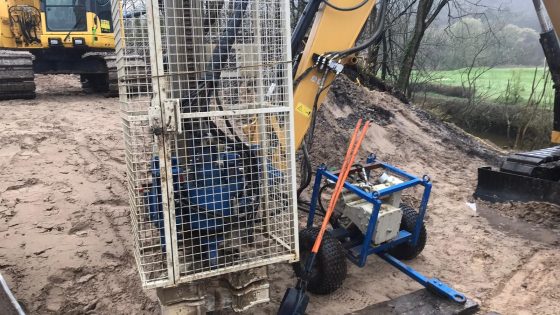
    Immediate load capacity of helical anchors and piles at installation is being challenged by data showing significant “aging” effects, with shaft resistance and overall capacity increasing measurably over days to months in clays and some sands. The discussion contrasts torque-correlated design methods with time-dependent capacity gains, referencing field load tests where post-installation capacity growth alters factor-of-safety assumptions and serviceability performance. For practitioners, the key issue is whether to rely solely on installation torque or to incorporate waiting periods and ageing factors into design for temporary works, tiebacks and lightly loaded foundations.

    Related Industries & Products

    Construction

    Quality control software for construction companies with material testing, batch tracking, and compliance management.

    Mining

    Geotechnical software solutions for mining operations including CMRR analysis, hydrogeological testing, and data management.

    HYDROGEO-io

    Comprehensive hydrogeological testing platform for managing, analysing, and reporting on packer tests, lugeon values, and hydraulic conductivity assessments.

    GEODB-io

    Centralised geotechnical data management solution for storing, accessing, and analysing all your site investigation and material testing data.

    QCDB-io

    Comprehensive quality control database for manufacturing, tunnelling, and civil construction with UCS testing, PSD analysis, and grout mix design management.