Geomechanics.io

  • Free Tools
Sign UpLog In
    AllGeotechnicalMiningInfrastructureMaterialsHazardsEnvironmentalSoftwarePolicy

    Geomechanics.io

    Geomechanics, Streamlined.

    © 2026 Geomechanics.io. All rights reserved.

    Geomechanics.io

    CMRR-ioGEODB-ioHYDROGEO-ioQCDB-ioFree Tools & CalculatorsBlogLatest Industry News

    Industries

    MiningConstructionTunnelling

    Company

    Terms of UsePrivacy PolicyLinkedIn
    Product

    Polypipe Aylesford automation: process, quality and staffing shifts for engineers

    March 6, 2026|

    Reviewed by Tom Sullivan

    Polypipe Aylesford automation: process, quality and staffing shifts for engineers

    First reported on The Construction Index

    30 Second Briefing

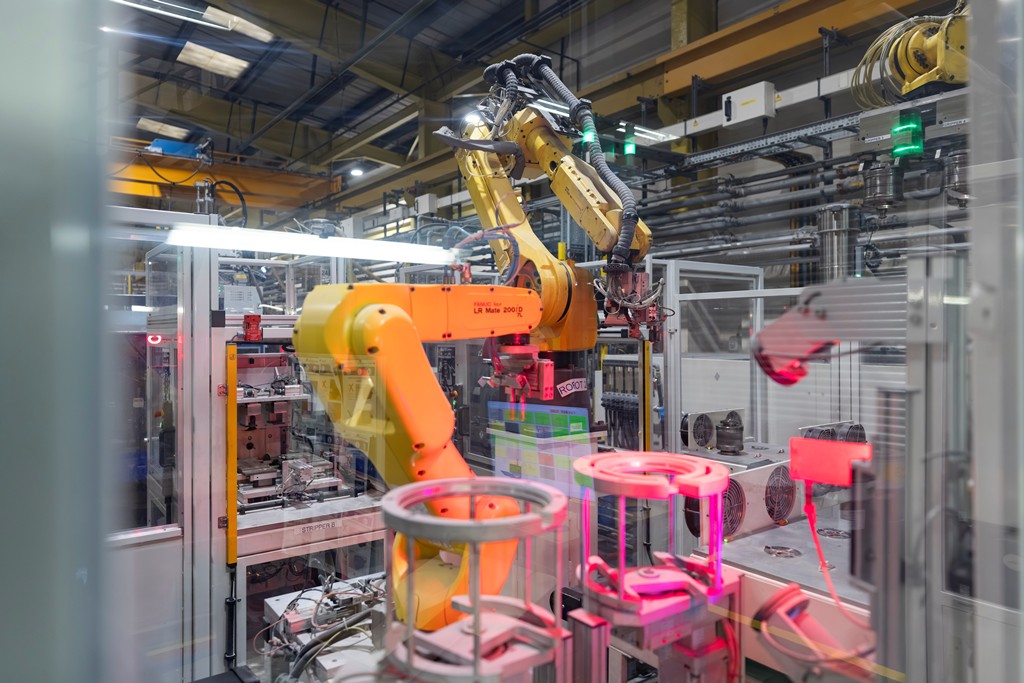
    Plastic pipe manufacturer Polypipe Building Services has invested £1.5m in automation, £3m in moulding machinery and £2.5m in extrusion technology at its 24-hour, five-day Aylesford plant, moving key lines to fully automated operation. Six-axis and Cartesian robots now handle production and packaging, while an IV4 AI vision camera counts parts and flags dimensional variation, ovality and moulding defects before dispatch. Operator loading has shifted from one operator per machine to typically one per four machines, with staff redeployed and further automation planned in the fabrication department.

    Technical Brief

    • Automation strategy is explicitly framed to offset labour shortages while still increasing production capacity.
    • Fully automated lines are concentrated in “key areas” of the factory, not yet site-wide.
    • AI-driven inspection is integrated into quality assurance to enforce drainage pipe dimensional and defect criteria.
    • Robotic and AI systems are credited with reducing waste through improved production consistency and defect detection.
    • Workforce impact is managed via redeployment, with no significant redundancies reported despite higher throughput.
    • An automation apprentice has been recruited, with further engineering team expansion planned to support new systems.
    • Next automation phase targets the fabrication department, currently reliant on manual prefabricated pipe system manufacture.

    Our Take

    Running the Aylesford facility on a 24/5 cycle with a shift from a 1:1 to 1:4 operator-to-machine ratio signals that Polypipe Building Services is targeting labour productivity gains that could buffer UK manufacturing margins against wage inflation and skills shortages.

    The combined £7m-plus spend on automation, moulding and extrusion at the Aylesford production site suggests Genuit Group is anchoring high-volume fabrication capacity in the UK rather than offshoring, which may appeal to infrastructure clients prioritising local content and shorter supply chains.

    Within our 38 Materials stories, most Product-tagged items focus on new formulations or low-carbon offerings; this kind of process automation investment by Polypipe is less common and indicates a push to compete on cost and lead time rather than purely on product differentiation.

    Geotechnical Software for Modern Teams

    Centralise site data, logs, and lab results with GEODB-io, CMRR-io, and HYDROGEO-io.

    No credit card required.

    • Save and export unlimited calculations
    • Advanced data visualisation
    • Generate professional PDF reports
    • Cloud storage for all your projects

    Prepared by collating external sources, AI-assisted tools, and Geomechanics.io’s proprietary mining database, then reviewed for technical accuracy & edited by our geotechnical team.

    Related Articles
    Carbon-catching concrete: Paebbl’s CO₂ mineralisation explained for engineers
    Materials
    1 day ago

    Carbon-catching concrete: Paebbl’s CO₂ mineralisation explained for engineers

    Nordic–Dutch startup Paebbl is producing an olivine-based cement substitute via accelerated CO2 mineralisation in low-energy reactors, claiming a net negative footprint of –14.4kg CO2‑equivalent per tonne (cradle-to-gate) and storage of about 21kg CO2 per m³ of concrete at typical replacement rates. The material has moved from gramme-scale tests to an operational pilot in 18 months and has already been used in a Rotterdam quay wall grout by Hakkers, the 1917 Veerhuis restoration, and a 7m-span “carbon-neutral” concrete footbridge by Heijmans. Classified as CCUS, the process permanently binds captured industrial CO2 into stable carbonate minerals that remain locked in even after demolition, offering structural-grade, carbon-storing concrete mixes rather than purely low-embodied-carbon variants.

    Turning sawdust into fire‑resistant boards: design notes for materials engineers
    Materials
    5 days ago

    Turning sawdust into fire‑resistant boards: design notes for materials engineers

    Researchers at ETH Zurich and Empa have developed a recyclable sawdust–struvite composite board that is stronger in compression perpendicular to grain than spruce and shows cone calorimeter ignition times of 45 seconds, around three times longer than untreated timber. The material uses an enzyme from watermelon seeds to control crystallisation of struvite from newberyite, forming large crystals that infill voids between sawdust particles and act as an inorganic flame retardant, potentially matching cement‑bonded particleboard fire classes with only 40% binder by weight. Panels can be mechanically ground, heated to just over 100°C to release ammonia, and fully separated for reuse or as a phosphorus fertiliser, with future cost reductions possible by sourcing struvite from sewage treatment plant deposits.

    Atlas Copco hybrid generators: design, duty-cycling and CO₂ cuts for site engineers
    Materials
    6 days ago

    Atlas Copco hybrid generators: design, duty-cycling and CO₂ cuts for site engineers

    Atlas Copco has launched QHS integrated hybrid generators that combine battery storage and a diesel genset in a single canopy unit, capable of grid charging, self-charging via the engine, and optional solar panel input. The system automatically manages multiple energy sources to minimise engine runtime, claiming up to 80% fuel and CO₂ reductions and more than 95% less engine operating time versus diesel-only sets at low or variable loads. Rental-focused features include multiple socket configurations, external fuel connections, a terminal board and FleetLink telemetry for remote monitoring, diagnostics and fleet management.

    Related Industries & Products

    Construction

    Quality control software for construction companies with material testing, batch tracking, and compliance management.

    Mining

    Geotechnical software solutions for mining operations including CMRR analysis, hydrogeological testing, and data management.

    QCDB-io

    Comprehensive quality control database for manufacturing, tunnelling, and civil construction with UCS testing, PSD analysis, and grout mix design management.