Geomechanics.io

  • Free Tools
Sign UpLog In
AllGeotechnicalMiningInfrastructureMaterialsHazardsEnvironmentalSoftwarePolicy

Geomechanics.io

Geomechanics, Streamlined.

© 2026 Geomechanics.io. All rights reserved.

Geomechanics.io

CMRR-ioGEODB-ioHYDROGEO-ioQCDB-ioFree Tools & CalculatorsBlogLatest Industry News

Industries

MiningConstructionTunnelling

Company

Terms of UsePrivacy PolicyLinkedIn
    Safety

    Construction worker fatalities 2025/26: HSE data and risk lessons for site engineers

    July 1, 2026|

    Reviewed by Tom Sullivan

    Construction worker fatalities 2025/26: HSE data and risk lessons for site engineers

    First reported on New Civil Engineer

    30 Second Briefing

    Construction recorded the highest number of worker fatalities in Britain in 2025/26, according to new Health and Safety Executive (HSE) figures on work-related deaths. Although absolute numbers are not yet broken down publicly by sub-sector, the data place construction ahead of manufacturing, agriculture and waste, continuing a long-term pattern of disproportionate risk. The figures will sharpen scrutiny of temporary works design, work-at-height controls and plant–people interface management on sites, particularly for SMEs and subcontractor-heavy projects.

    Technical Brief

    • HSE classifies fatalities by main industry of the employer, not by project type or client sector.
    • Work-related deaths in public spaces (e.g. members of the public near sites) are recorded separately from worker fatalities.
    • Annual release enables year-on-year comparison of fatality rates per 100,000 workers by sector.
    • HSE uses these statistics to target proactive inspections and enforcement campaigns on higher-risk activities.
    • For site teams, the dataset provides a benchmark to test whether corporate fatal risk controls are delivering below-sector rates.

    Our Take

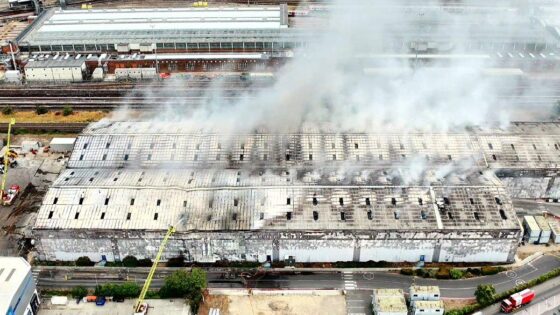
    The Esso Fawley Refinery and Willow Services (Southern) Ltd cases show HSE using substantial fines in both process safety and small-contractor contexts, which means UK construction firms cannot assume that only major industrial operators will face high-visibility sanctions when fatalities occur.

    Geotechnical Software for Modern Teams

    Centralise site data, logs, and lab results with GEODB-io, CMRR-io, and HYDROGEO-io.

    No credit card required.

    • Save and export unlimited calculations
    • Advanced data visualisation
    • Generate professional PDF reports
    • Cloud storage for all your projects

    Prepared by collating external sources, AI-assisted tools, and Geomechanics.io’s proprietary mining database, then reviewed for technical accuracy & edited by our geotechnical team.

    Related Articles

    Sellafield worker death: ONR findings and safety oversight notes for engineers
    Hazards
    11 days ago

    Sellafield worker death: ONR findings and safety oversight notes for engineers

    A worker at the Sellafield nuclear decommissioning site “died suddenly” during the week commencing 6 July, prompting an immediate review by the Office for Nuclear Regulation (ONR). ONR has confirmed the death was not work-related and that there was no radiological or conventional safety incident affecting the wider site. Routine regulatory oversight of Sellafield’s legacy waste facilities, spent fuel management and construction activities continues unchanged, with no impact reported on nuclear safety cases or site operations.

    BGS River Tweed groundwater survey: flood model lessons for infrastructure engineers
    Hazards
    17 days ago

    BGS River Tweed groundwater survey: flood model lessons for infrastructure engineers

    The British Geological Survey has launched a four‑year ground investigation of the River Tweed catchment to characterise groundwater behaviour and its interaction with river levels for improved flood forecasting. Work will include installing new monitoring boreholes, logging groundwater heads and flow paths, and integrating hydrogeological data with existing river‑gauge and rainfall records across the cross‑border catchment. Findings are expected to refine flood models used by local authorities and infrastructure owners, particularly for groundwater‑dominated flood events and prolonged saturation of transport and drainage assets.

    Worsening wildfire seasons for mine operators: design and continuity lessons
    Hazards
    19 days ago

    Worsening wildfire seasons for mine operators: design and continuity lessons

    Wildfire seasons in Western Canada are intensifying, with 2023 seeing more than 2,240 fires burning 2.84 million hectares in B.C. and insured losses of $720 million in the Okanagan/Shuswap and $1.3 billion from the 2024 Jasper fire, forcing repeated evacuations at sites such as Artemis Gold’s Blackwater and Cameco’s Cigar Lake. Operators and insurers are now treating wildfire as a core business-interruption risk, driving investment in backup generation for long transmission corridors, detailed continuity planning, and stricter underwriting. Engineers are also redesigning mine layouts and buildings for fire, favouring sites on ridge tops, wider building separation, non-combustible steel roofing and use of natural and linear infrastructure firebreaks.

    Related Industries & Products

    Construction

    Quality control software for construction companies with material testing, batch tracking, and compliance management.

    QCDB-io

    Comprehensive quality control database for manufacturing, tunnelling, and civil construction with UCS testing, PSD analysis, and grout mix design management.