Canada’s mining industry reform push: project approvals and fiscal levers for engineers
Reviewed by Tom Sullivan
First reported on MINING.com
30 Second Briefing
Canada’s mining sector generated C$111 billion of GDP in 2024 and C$152 billion in mineral exports (21% of all merchandise exports), yet the Mining Association of Canada is warning that slow project approvals and uncompetitive fiscal terms are eroding the country’s position amid volatile, trade-restricted critical mineral markets. MAC is urging Ottawa to accelerate federal impact assessments and permitting, improve federal‑provincial coordination, and expand northern geoscience and resource assessments. It also wants broader Canadian Exploration Expense eligibility, tax credits for brownfield expansions, and rapid implementation of 2025 budget measures such as clean technology credits and accelerated capital cost allowances.
Technical Brief
- Gold exports averaged C$4.3 billion per month in the first 10 months of 2025.
- Including mining, quarrying and oil and gas, extractive industries exceed 5% of national GDP.
- Alberta’s mined oil sands are identified as a major contributor to that >5% GDP share.
- In 2024, the US took 51% of Canada’s mineral and metal exports by value.
- The UK and EU accounted for 15.6% and 7.7% respectively of 2024 mineral export value.
- Canada imported C$126 billion of minerals and metals in 2024; 45.8% originated from the US.
- China supplied 11.9% and the EU 9% of Canada’s 2024 mineral and metal imports.
- MAC flags concentrated global mining/processing capacity as a key driver of supply‑disruption risk.
- Budget 2025 incentives are explicitly targeted at defence, semiconductor and clean‑technology mineral supply chains.
Our Take
With over half of Canada’s minerals and metals exports going to the United States and a further 15.6% to the UK, any MAC‑backed reforms that speed project approvals for copper and other critical minerals would directly reinforce North American and trans‑Atlantic supply chains that are already heavily Canada‑dependent.
Our Policy coverage includes several MAC‑linked pieces, such as the EU CBAM analysis where Canadian nickel and copper could gain a carbon‑cost edge; aligning domestic reforms with these external carbon and trade regimes will be critical if Canada wants its C$152 billion export base to stay competitive against lower‑cost jurisdictions like China.
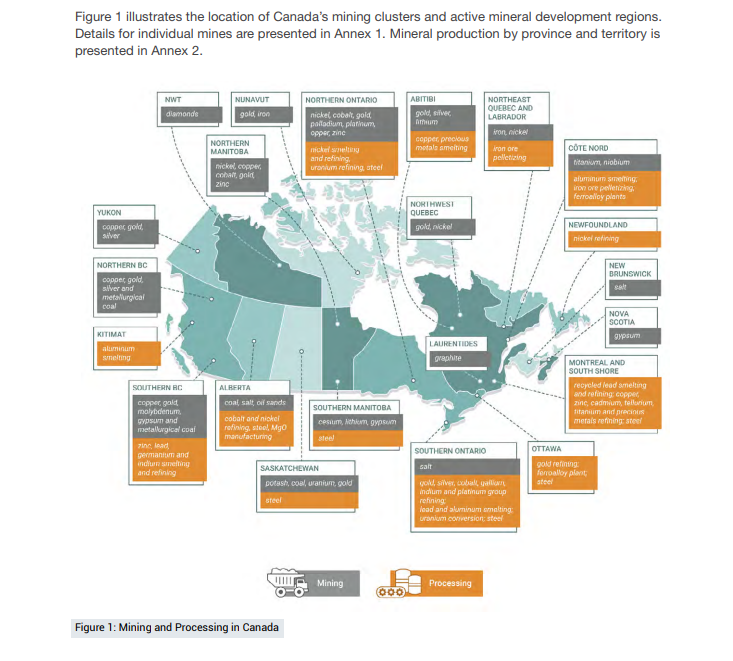
Nouveau Monde Graphite’s presence in this debate underlines that graphite and other critical minerals are no longer niche in our database: they increasingly sit alongside gold and copper in project pipelines, especially in northern Canada, where permitting and infrastructure decisions will determine whether Canada can capture more of the C$126 billion it currently imports in minerals and metals.
Prepared by collating external sources, AI-assisted tools, and Geomechanics.io’s proprietary mining database, then reviewed for technical accuracy & edited by our geotechnical team.
Related Articles

Related Industries & Products
Mining
Geotechnical software solutions for mining operations including CMRR analysis, hydrogeological testing, and data management.
Construction
Quality control software for construction companies with material testing, batch tracking, and compliance management.
CMRR-io
Streamline coal mine roof stability assessments with our cloud-based CMRR software featuring automated calculations, multi-scenario analysis, and collaborative workflows.
HYDROGEO-io
Comprehensive hydrogeological testing platform for managing, analysing, and reporting on packer tests, lugeon values, and hydraulic conductivity assessments.
GEODB-io
Centralised geotechnical data management solution for storing, accessing, and analysing all your site investigation and material testing data.